Tāngata · People 293
See all 293 →
Dr Andrea Reid
Dr. Andrea Reid is a citizen of the Nisga’a Nation and an Associate Professor with the University of British Columbia’s Institute for the Oceans and Fisheries. She has launched and is leading the Centre for Indigenous Fisheries, working to build an inclusive hub for the study and protection of culturally significant fish and fisheries. Her research program adopts highly interdisciplinary and applied approaches to improving our understanding of the complex interrelationships between fish, people and place. Reid’s PhD in Biology (Governor General’s Gold Medal; Carleton University, 2020) centred on multiple stressor effects on Pacific salmon, using tools and insights from Indigenous and Western sciences in tandem. Reid is a cofounder of Riparia, a Canadian charity that connects diverse young women with science on the water to grow the next generation of water protectors. She is also a National Geographic Explorer and a Fellow of The Explorers Club.
Dr Coen Hird
Coen is an environmental scientist and ARC DAATSIA Fellow in the School of the Environment at The University of Queensland. His research reaches across Indigenous studies, environmental sciences, animal ecology and science and technology studies in asking how research can better respond to Country.
Coen's work spans several connected areas: native stingless bee science; herpetofauna and environmental physiology; Indigenous Data Sovereignty; and the ethics and epistemology of environmental research. His current projects are focused on how culturally significant organisms are studied, monitored and cared for.
Coen is a trawlwoolway pakana related to northeast lutruwita (Hearps, Briggs family) and is accountable to the Tasmanian Aboriginal community. Coen grew up as a visitor to many lands in so-called Australia and currently is living on Yuggera land at Tulmur.
Dr Susanna Ragnhild Andersdatter Siri
Jeg er Fimben-Áillu-Ántte Susanna ja Gáren-Niillas-Máhte-Ristena Susanna, men døpt som Susanna Ragnhild Andersdatter Siri. Som forsker ved Senter for samisk helseforskning har jeg ansvar for biobank delen til SAMINOR undersøkelsen hvor alle blodprøvene er lagret. Jeg har tatt doktorgrad i emne epidemiologi og temaet for doktorgraden (2021) var risikofaktorer og risikoen for hjerte- og karsykdommer hos samer og ikke-samer. Siden 2021 har jeg engasjert meg i spørsmål om urfolks rett til selvbestemmelse over egne forskningsdata og har sammen med førsteamanuesis Per Axelsson ved Umeå Universitet ledet GIDA-Sápmi nettverket som er et nordisk samisk nettverk. GIDA-Sápmi nettverket ledes av oss sammen med forsker I, Rauna Kuokkanen fra Lapland Universiet i Finland.
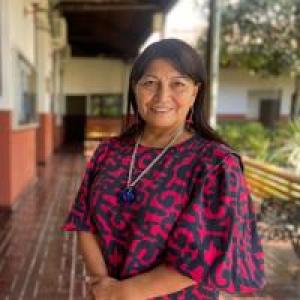
Professor Elisa Loncon
Elisa Loncón currently works at the Departamento de Educación, University of Santiago, Chile. Elisa does research in Syntax, Sociolinguistics and Morphology. Their most recent publication is 'Educación mapuche y Educación Escolar En la araucanía: ¿doble racionalidad Educativa?'. and, El poder Creativo del mapuzugun y la formación de neologismos
Kaupapa · Projects 470
See all 470 →Te kāhui kūaka: he tupuna, he taonga, he tohu
Maiea Te Mauri; Taiea Te Taiao: Connecting Indigenous Knowledge, Climate Change and Kōrero Tuku Iho for a Sustainable Future.
Evaluating and Enhancing the Kimi Ora Diabetes Programme through AI-Driven Innovation
Exploring Mātauranga Māori in sustainability-related disclosures in Aotearoa business entities
He Mahinga-Ora ki te Tairāwhiti: 'Ki te whai-ao, ki te ao-mārama'
Ō Kōrero · Our Stories 43
See all 43 →Hīnātore Sparks Research in Aquaculture
A childhood visit to glow worm caves left researcher Aymee Lewis (Ngāti Kahungungu ki Te Wairoa, Ngāti Rakaipaaka) with an enduring curiosity about creatures that glow in the dark. Today, Aymee’s fascination has not diminished, and the phenomenon of bioluminescence has become a focus of her PhD.
Bioluminescence is produced by naturally occurring chemical reactions in certain bacteria, fungi, insects and marine life. It’s the reason why some caves, waves and shadowy places appear to magically glow in the dark, she says. Despite the mystical appearance, Aymee’s research is hoping to spotlight more practical concerns.
Photobacterium spp. is the specific bacteria that causes glow, and Aymee is looking at whether it can be used in the aqua-culture industry. Specifically, her MAI Te Kupenga supported PhD looks at whether bioluminescence can be used in formulated fish food to improve the feeding of baby snapper.
Aymee says the aqua-culture industry has enlisted the help of scientists to help it diversify beyond farming shellfish and salmon. She says the benefit of raising farmed fish in the ocean is that it could relieve pressure on wild fish populations and help the industry become more sustainable.
Previous research shows young snapper are not thriving in hatcheries as they are unable to detect or respond to non-live food. The purpose of her research is to explore whether glowing bacteria can help attract baby snapper to fish food in hatcheries.
Her research focused specifically on the conditions bioluminescent bacteria need to create a strong glow; to find out if the bacteria can be used in live fish and non-live fish food; and to measure if baby snapper are attracted to food containing bioluminescence.
Her research results have been mixed. The research has generated rich data on bioluminescence — how it works, the conditions needed to produce a glow, and the development of glowing feeds — but current findings suggest baby snapper may not actually be attracted to bioluminescent food. Further analysis is still underway.
“What my research underscores is that nature is far more complex and as scientists, we are still determining what these factors are. So, I’m happy my research is helping move our knowledge base forward and other scientists can now use my results to continue experimenting,” says Aymee.
While economic outcomes are a focus, mātauranga has been foundational to her approach. According to Māori cosmology, Hīnātore is the entity of phosphorescent and bioluminescent light, the faint twinkle or glow seen in glowworms, and sea life. Aymee wanted to combine mātauranga with PhD research and went home to Wairoa to kōrero with whānau, hoping to gain a deeper understanding of Hīnātore.
“My whānau and community were very helpful, and having my kaumatua, Richard Niania, work alongside me, really helped me in this space. His knowledge, combined with disciplinary science, enabled me to have a much deeper and more reverent approach to the bacteria I work with.”
"We can’t live without bacteria. It’s everywhere in our lives, so for me as Māori scientist to have reverence for these organisms instead of just seeing them as a cloudy substance in a dish that I’m going to measure, it brings to life my values. These bacteria are amazing and magical, and I think if we take care of bacteria, they will take care of us. It is important to uphold the kaitiaki between us."
Exhibition:
Aymee is collaborating with Paraone Luiten-Apirana, Dan Hikuroa and Siouxsie Wiles for an art exhibition focusing on Hīnātore. The exhibition combines art and science and aims to awaken people’s curiosity about bioluminescence.
Where: Project Space, ELAM, University of Auckland
When: July 18, 10.30 am
Manukura: A Vision of Excellence
Manukura has been punching above its weight for over 20 years and now one of its own is digging into the reasons for its success. Keita Durie (Ngāti Kauwhata, Ngāti Raukawa, Rangitāne, Ngāi Te Rangi) has been undertaking research on the kura as part of doctoral study, supported by a NPM PhD scholarship.
Keita was in the second cohort of MANUKURA, beginning her secondary school journey in 2007. During this time, she saw first-hand how committed the school’s founders were to keeping the doors open and offering a different model of education for ākonga Māori.
Her whānau connections to the kura include her great-uncle, Tā Mason Durie, Uncle Nathan Durie, his wife Yvette Durie, and Uncle Rawiri Durie. All were visionaries who could see that a commitment to excellence was the way forward for Māori students in their high school years, she says.
With a role of only 12 students on the first day, the school opened its doors in 2005 under the mana of Aorangi Marae. Self-funded in the beginning, Keita remembers years of the school whānau delivering phone books and selling hāngī to keep the school operating.
“They were offered money from the Ministry of Education from a ‘Māori at risk’ fund, but this was rejected because the school did not want students to be framed in this way,” says Keita.
However, the lack of funding also had an upside and teachers had the freedom to deliver their curriculum in the way they knew worked, says Keita. Tā Mason's influential Māori health model Whare Tapa Whā was foundational to their approach to learning and ākonga well-being. Like many Māori education settings of the time, reo, tikanga and mātauranga Māori were embedded into learning, alongside two other important pou: elite sport and academic excellence.
“Aunty Yvette was an elite athlete herself, and she knew sport could be a catalyst to motivate ākonga. Uncle Nathan was devoted to teaching, and he was determined that students, particularly boys, would attain the educational excellence he knew they were capable of.”
Keita has interviewed former ākonga, whānau, staff, and school board trustees about those early years to better understand how the kura’s founding principles, teaching practices, and aspirations for ākonga contributed to long-term success.
Now raising their own families, former ākonga described the school’s focus on health and fitness, not only for themselves but also for their wider whānau as important to success. “Parents of former students told me their children’s healthy eating and commitment to fitness rubbed off on the wider whānau, who could see the value and began making changes themselves. One whānau entered a half marathon together as part of that commitment,” says Keita.
Keita heard a clear theme - that goal-setting support, elite sporting coaches, and specialist teachers all played a vital role in helping students reach their potential. They were treated as elite athletes with high-performance coaches and nutritionists to help attain goals." These insights resonated with Keita's own experience at MANUKURA. "From a young age, we had teachers who believed in us, cared for us, and walked alongside us the whole way,” she says.
While individual goals often changed over time, the process of goal setting helped develop habits that carried into adulthood, including how to organise themselves, develop strategies, think critically, and stay focused on what mattered to them.
While sport and academic excellence were important, Keita says her research found that one of the most significant things for former ākonga was the way the school affirmed who they were as Māori. At MANUKURA, gaining NCEA credits was seen as the baseline, not the ultimate and students were expected to go beyond that. “While there was a big focus on careers after high school, the bigger aim was growing successful adults who were proud to be Māori, who understood how to take care of their wellbeing, and who were engaged in their communities,” says Keita.
“Being proud to be Māori was huge. Many of those first ākonga now have their own children and many have chosen Māori educational pathways for them. The impact of the school has rippled out to the next generation. Parents of former students said the school was also transformational for them. Some were inspired to take te reo classes at wānanga. So the impact has not just been on one generation, but on three. There was also a strong theme of former ākonga wanting to give back to their communities,” she says.
Ultimately, Keita says, what stood out most was the gratitude former ākonga had for their teachers and for the way MANUKURA walked alongside them. “The kura’s holistic approach, with its focus on long-term wellbeing, excellence and being secure as Māori, helped set them up for lifelong success.
HARAKEKE 3D-PRINTED PROSTHETICS
Harakeke fibre could be used to create 3D-printed prosthetic limbs, helping them become more wearable, according to engineer and NPM researcher, Dr Mahonri Owen.
Mahonri is supported by a NPM Matakitenga grant with the hope that the research will help solve the issue of why so many people reject their prosthetics.
Mahonri says more than a third of people suffering limb loss end up rejecting their artificial replacement. Given that artificial hands can cost between US$40,000 to $100,000 to create, this is a situation he wants to remedy.
Mahonri says Māori have a high number of people who are missing limbs due to higher rates of Type 2 diabetes, as well as a higher proportion working in dangerous jobs. People reject artificial limbs for a variety of reasons and one is due to a lack of connection with the substitute limb. “People have reported that they don’t like wearing prosthetic limbs because they feel no sense of belonging to the limb,” he says. Other reasons for not using limbs include a lack of functionality and comfort which are also aspects he will explore.
“My research is delving deeper into understanding people’s attitudes and why Māori may feel a sense of alienation from these devices. We know everything has a whakapapa and a mauri and so I wondered if we could create a prosthetic limb with materials that had been grown on our own whenua, such as harakeke. Perhaps then the limb might become more meaningful, and these devices would be more readily accepted.”
Before the 3D-printing process starts, Mahonri and the research team are holding wānanga with people who use assisted technology on their bodies to understand what their perspectives are. The wānanga will include people who use artificial limbs, those with cochlear implants, and those with glasses.
Raranga practitioners will also be invited to provide guidance on the appropriateness of creating prosthetics out of harakeke. Mahonri says the process of preparing harakeke for 3D-printing is much like harvesting for raranga. After the muka is removed, it is chopped into small fibres and then mixed with a corn starch 3D-printing filament. Between 10 – 30% of the final filament mix used for 3D-printing will be harakeke.
Infusing harakeke with the polymer has the added benefit of increasing tensile strength which will improve functionality, he says. Mahonri hopes this research will be helpful for all people who suffer limb loss - not just Māori. “It also has potential for other Indigenous peoples who might want to use their own plants to make 3D-printed limbs, or it could be used in war torn countries with have high rates of limb loss,” he says.
Mahonri says 3D printing technology is particularly beneficial because it can create individualized solutions from a relatively inexpensive and small machine. “People can now have 3D printers sitting on their desks at work,” he says.
Mahonri and the team at Te Kura Rau Mahara, based at the University of Waikato, will be looking at all aspects of improving prosthetic functionality. Their research will include the creation of a brain-controlled prosthetic hand. “Neural prosthetics - the hands that our students make - will be controlled by a headset or muscles, and eventually it is hoped harakeke will be part of the eventual printing process.”
This research has seen the team combine the use of mātauranga with Western approaches to innovate and find new neural solutions. “Using pūrākau, such as the origin story of Hineahuone, guides us to understand a different way of thinking about interactions within the brain that might be helpful neurologically,” he says.
“In some ways Māori frameworks align with current neuroscience, which is cool, even though they both come from very different places. Using Māori frameworks doesn’t take away from neuroscience, it gives another perspective of how we might want to look at the brain and come up with possible solutions to problems,” says Mahonri.
He believes there is a lot of scope and potential for engineers to take a more holistic approach that is inclusive of Indigenous knowledges. “We engineers are supposed to get as many perspectives as we can to deliver better outcomes. Personally, I have deliberately worked across different fields of science including robotics, biomechanics, health and neuroscience because I believe we can be more innovative when we collaborate.”
“It has been hugely advantageous to me to use all knowledge systems to solve problems, including that of the hard sciences, across to the social sciences, as well as Indigenous perspectives,” says Mahonri.
kōrero with Dr Ani Kainamu
Each month we feature one of our NPM lead researchers. This month our kōrero is with Dr Ani Kainamu. Ani is the Kaihautū Māori Research Impact Leader at Bioeconomy Science Institute (BSI).
Ko wai tō ingoa, nō whea koe?
Ko Ani Kainamu ahau, he uri ahau nō Rāhiri, nō Kahukuraariki - ko Ngāpuhi, ko Ngāti Kahu ki Whangaroa ngā iwi. Nō Kōtirana anō hoki taku matua, ā, nui tana tautoko i Te Tiriti i a ia e ora ana.
E noho ana mātou ko aku tamariki i roto i a rāua, i Te Waka o Aoraki. He Kāi Tahu, he Ngāti Raukawa anō hoki aku tamariki.
I believe it is important to acknowledge my tūpuna, as well as the haukāinga of the takiwā we now call home. While my whānau are from Te Tai Tokerau, and my father immigrated to Tāmaki Makaurau from Glasgow, I have lived within Te Waka o Aoraki for over a decade. I am grateful to be supported by mentors and peers of Kāi Tahu, and to now be raising my tamariki close to their whenua tīpuna.
What are your areas of research?
I specialise in environmental research across māra kai and mahinga kai, from land to marine ecosystems. Given the essential framing of te ao Māori in my research, it recognises the health of people, the environment, and food systems. I draw on mātauranga Māori and science to understand environmental health, bioindicator species, such as mātaitai/shellfish, and contaminant pathways ki uta ki tai. The majority of my mahi is undertaken in partnership with hapū and iwi to support kaitiakitanga.
What excites you about your work?
There are many barriers to the full expression of kaitiakitanga, especially within the marine environment, so I am motivated to identify and co-develop approaches with amazing tangata tiaki and collaborations with colleagues - internally and externally - that bring our collective efforts towards sustainable futures aligned with Te Tiriti o Waitangi.
Our NPM vision is flourishing Māori futures. What does that mean for you?
For me, flourishing Māori futures means supporting and resourcing Māori environmental-based research and hapū aspirations to create lasting impact. This is inherently connected to environmental well-being, where the health of people and ecosystems is interdependent. With few Māori, particularly senior Māori researchers, within the RSIT sector, NPM plays an important role in recognising and supporting this, helping to realise these connections in research practice and leadership.
Creating Kūmara Connections
It’s a common occurrence for Amelia Blundell to see a photograph of her nan’s hands on the side of delivery trucks. The trucks are delivering kūmara from the Kaipara Kūmara packhouse in Ruawai to supermarkets across the motu. The image of her nan cradling the iconic plant is symbolic of the Blundell whānau’s deep connection to the kūmara growing communities in the Kaipara.
Amelia’s nan (Robin Blundell) and pop (Gary Blundell) established the kūmara growing cooperative Kaipara Kūmara in the early 1970s to enable small growers to combine forces so they could improve the supply chain, making it easier for them to get the kai from the field to supermarket shelves.
This whakapapa has inspired Amelia (Ngāpuhi, Ngāti Kahu ki Whangaroa) to undertake a PhD study on how people relate to kūmara across time, place and cultures. Her research explores communities’ narratives of their relationships to the plant, including their harvesting practices, watering, feeding and growing cycles and kōrero tuku iho.
“Whether it’s a commercial grower, worker in the factory or out in the fields, or people who grow kūmara in their own maara, my research aims to understand people’s relationship with kūmara, and it will look at whether plants can be a conduit to deeper and more balanced relationships with taiao,” she says.
Amelia hasn’t always been enamored with the plant. As a child, much of her school holidays were spent working in packhouse grading, washing and packing kūmara. After finishing high school, Amelia couldn’t wait to get as far away from the family business as possible. Her undergrad studies in landscape architecture gave her a new appreciation of the plant — not just as a source of kai and employment, but as something deeper. For some communities, kūmara is bound up with who they are, she says.
Through the course of undertaking her PhD, and spending time with different “kūmara communities”, Amelia says she has come to see plants as tuakana. She credits Kai Rotorua kaumātua Te Rangikaheke Kiripatea with helping her understand how our relationships with plants and the taiao are constantly evolving.
Closer to home, Amelia’s father, Peter Blundell, and her uncle, Anthony Blundell, work managing and directing Kaipara Kūmara and are keen to be part of the evolving relationship between plants, taiao and people. “My dad and uncle totally support me, because they don’t often get the time or resources to think about the bigger picture. I’m hopeful that my research could create opportunities for people working in our food system to create decisions that positively impact everyone and the plants we work with,” she says.
“Dad was super excited because he has been working with the plant most of his life, but it has been limited to the business day-in day-out getting kai on the supermarket shelves, so for him, this is an awesome opportunity to think deeper, encompassing all of the dimensions that make up his relationship with the kūmara. My uncle Anthony, who is the Director of Kaipara Kūmara, is always wanting to enrich everyone’s relationship to kūmara. He says kūmara has an amazing lifecycle and he wants to share it with staff so they too can be more connected to the plant, the whenua and the region of Kaipara.”
Amelia says her drive to start the PhD has come out of her love for plants and kūmara has been the vessel to explore this further in her own life. She says younger people, such as herself, are craving connection to nature. “We’ve grown up googling knowledge and outsourcing information which leads to less connection. But when it comes to growing, you need to experiment and watch nature to see how plants respond when you try things,” she says.
“Plants have an energetic presence in our lives. We are always in relationship to the plants around us so why not make those the deepest, most joyful and beautiful relationships they can be? I believe this is how our tūpuna saw the world and their place in it, and I’m hoping my PhD will in some way help people get back to those ways of seeing and experiencing the world.”
Sci-Fi Video Games and Māori Futurism
A Māori sci-fi fantasy video game is in development and NPM researcher Hine-Kaunuku (Morgana) Watson says it's been a long time coming.
Morgana (Taranaki, Te Atiawa, Te Atihaunui-a-Papaarangi, Ngāpuhi) has been under the spell of computer games since she was eight, when she became enthralled by the action-adventure games of the Atari 2600.
Thirty years later, computer gaming technology had advanced exponentially, but most of the game themes had not. For Morgana, games that reflected her own values and world views simply didn't exist.
“If you are a gamer, you know what you want to play and during my twenties I thought ‘I can’t wait until someone brings out a Māori God of War or a Māori Tomb Raider’. I reached my forties, and was still waiting, so I started writing an action adventure story for myself,” she says.
Morgana’s first test came when she sought her sons' feedback on her story. When she saw their excitement, she knew she was onto something good. “The most important thing in a video game is that it’s fun to play and has great story telling. However, I wanted to offer something specifically that Māori gamers, nerds, wāhine, and kohine would enjoy, so we embedded Te Ao Māori and traditional combat themes into the adventure.”
The game is called Ariki the Kaitiaki Saga, which Morgana has been evolving in her spare time while also working full-time. Because artistry and authenticity are also critical to game success, Morgana sought to collaborate with others who understood her vision. Artist Jojo Barber (Ngā Paerangi, Ngāti Kahungunu) agreed to come on board with the game development, as did kairākau exponent Matiu Awarāwhiti (Ngāti Porou, Ngāi Taharora), who was already developing his own board game.
“Mau rākau is integral to the fighting scenes, and I needed someone who understood the complexity of how it could translate over to a game in an authentic way,” says Morgana. The team have been working together since the Covid lockdowns, and the storyline has evolved to reflect real-world Māori concepts in a more in-depth way.
“For example, we use tapu and noa as a game mechanic which has never happened before. In a standard game when you take hits, you heal up, you keep going, but that doesn’t happen in Te Ao Māori, or our game. After you’re in a whawhai, you need to go through a process of whakanoa to rebalance and enable you to continue. It reflects our own world, where toa returning from war needed that process to heal from the trauma that was inflicted,” says Morgana.
Another critical element of the game is its representation of wāhine, as Morgana has become increasingly dissatisfied by the objectification, sexualisation and gender stereotypes entrenched in most games. “Ariki the Kaitiaki Saga needed to be different and Matiu and Jojo are totally on board with this. Our characters reflect all aspects of human personality, where any gender can be powerful, gentle, fierce and magical,” she says.
While females make up over half of gamers today, Morgana says they are starkly underrepresented in the gaming workforce. “It’s getting better, but there is still massive misogyny, objectification, and still stories being made for men through the male gaze.
“I want women to see that not only do we play video games, but we can make them as well.” She says there are many facets to being a game developer and the industry has huge potential for young women. Careers include software engineers, writers, artists, voice actors, as well as camera work. “There are so many diverse aspects that make up a good video game and wāhine can be part of this world,” she says.
Morgana says over 90% of homes have consoles or a smartphone and this technology has become part of who we are. She wants her NPM sponsored PhD to explore how interactive and authentic story telling might be a conduit to inspire people to visualise their own futures where they can manifest their own stories in the real world.
“That’s what Maori futurism is – it’s about the futures we create for ourselves. Free from colonial constructs, our narratives can work for us and reflect our own identities and visions.”
“It’s important for us to be able to create our own worlds, in our voice. If we don’t fill the space, someone else will and that’s been happening for too long. We need to tell our own stories.”
Ngā hui · Events 30
See all 30 →Hui · Events
Fulbright online information sessions 9 June and 7 July
Fulbright NZ are providing their final information sessions for this year for graduate and scholar awards, registration details below:
Hui · Events
Media Savvy Applications Open
Hui · Events
Atamai Hangahanga: AI and Māori Research, Friday, October 3, Noon
Join us for a discussion on the evolving role of Artificial Intelligence (AI) in rangahau Māori. This webinar will explore how AI technologies are complementing, enhancing and presenting challenges to Māori research and researchers. Featuring expert speakers from the Māori tech and research communities, we’ll delve into the ethical considerations, opportunities, and obstacles of integrating AI with traditional and contemporary Māori knowledge and practices. Whether you're a daily user of ChatGPT or a complete technophobe, this session is about sharing new perspectives on the intersection of Māori culture, technology, and research.
Hui · Events
Webinar: Towards Māori economies of wellbeing, Thursday, 28 August, 12noon
This groundbreaking research project centres whānau as catalysts for resilient, flourishing Indigenous futures. It explores how Māori families navigate work and livelihoods while nurturing a wellbeing-based economy grounded in te ao Māori. Through powerful insights and lived experiences, the study reveals the strength of grassroots, whānau-centred approaches. It shows how reconnecting with traditional values – kaupapa, tikanga, and collective leadership – can drive economic transformation from the inside out. At its heart, this project is a celebration of whānau innovation, self-determination, and the enduring potential of Indigenous knowledge systems to shape economic transformation that is equitable and sustainable.
Hui · Events
Lifeworlds: Beyond the Degree
This groundbreaking research project centres whānau as catalysts for resilient, flourishing Indigenous futures. It explores how Māori families navigate work and livelihoods while nurturing a wellbeing-based economy grounded in te ao Māori. Through powerful insights and lived experiences, the study reveals the strength of grassroots, whānau-centred approaches. It shows how reconnecting with traditional values – kaupapa, tikanga, and collective leadership – can drive economic transformation from the inside out. At its heart, this project is a celebration of whānau innovation, self-determination, and the enduring potential of Indigenous knowledge systems to shape economic transformation that is equitable and sustainable.
Hui · Events
NPM Summer Internship Applications Now Open
This groundbreaking research project centres whānau as catalysts for resilient, flourishing Indigenous futures. It explores how Māori families navigate work and livelihoods while nurturing a wellbeing-based economy grounded in te ao Māori. Through powerful insights and lived experiences, the study reveals the strength of grassroots, whānau-centred approaches. It shows how reconnecting with traditional values – kaupapa, tikanga, and collective leadership – can drive economic transformation from the inside out. At its heart, this project is a celebration of whānau innovation, self-determination, and the enduring potential of Indigenous knowledge systems to shape economic transformation that is equitable and sustainable.
Ngā kōrero · News 338
See all 338 →Kōrero · News
Call for research project applications for NPM & Borrin summer internships!!
Kōrero · News
NPM | Fulbright Awards Open!!
Kōrero · News
2026 Ngā Pae o te Māramatanga Matakitenga Research Round Now Closed
As a national Centre of Research Excellence, we value the connections that we have to our 21 partners Te Tira Takimano who share our vision of research that empowers flourishing Māori futures. This month we were grateful to be hosted on the whenua of Waikato-Tainui College for Research and Development for our two-day Kāhui Ārahi research impact wānanga. The wānanga was a timely opportunity for our senior leadership team to take a deep dive into research impact from a Te Ao Māori lens and to learn more about the research aspirations and priorities of our iwi partner. We look forward to taking our strategies and actions forward into 2026 and beyond.
Ngā Pou Matarua | Co-Directors
- Professor Tahu Kukutai
- Professor Melinda Webber
Kōrero · News
PhD Scholarships Are Closed for 2025
Are you a Māori doctoral candidate ready to lead bold, kaupapa Māori research that transforms communities?
Ngā Pae o te Māramatanga’s 2026 PhD Scholarships are now open, supporting Māori researchers to shape the future through Indigenous excellence
Closes: 10 November 2025
Apply now
Hangaia he tūāpapa kia Puāwai ai Te Ao Māori | Building the foundations for flourishing Māori futures
Let’s grow the next generation of Māori research leaders.
Kōrero · News
NPM Social Media Success Webinar: Learn How to Create Greater Research Impact 2025
This webinar series is targeted towards early-career researchers and PhD candidates wanting to use social media for greater research impact.
We have chosen five highly successful social media influencers who will share the key elements to their success.
Hosted by Associate Professor Awanui Te Huia, the series will take place during the month of May and June, 2025.
Week One: Luke Fitzmaurice-Brown Thursday Social Media Use and Te Tiriti o Waitangi
Thursday 1st May, 12 -1pm
Week Two : Eru Kapa-Kingi Using Social Media as a Tool for Promoting Social Justice
Thursday 15 May, 12-1pm
Week Three: Te Amohaere Ngata-Aerengamate Māori, Kina, and Climate Change – Communicating Complex Kaupapa Through Storytelling
Thursday 22 May, 12-1pm Mātauranga
Week Four: Rangi Mātaamua Matariki – The Creation of a Public Holiday and Social Media.
Thursday 29 May, 12-1pm
Week Five : Riana Te Ngahue Understanding Your Audience & Platform – Who Are You Talking To?
Thursday 5th June,12-1pm
Kōrero · News
2025 Ngā Pae o te Māramatanga Matakitenga Research Round Now Open
The 2025 Ngā Pae o te Māramatanga Matakitenga Research Round is now open.
We invite research applications aligned across our Matakitenga Research Framework – this year priority will be given to Pae Auaha applications (our Te Ao Māori data and digital technologies domain). ). Applications for the other Pae (Tawhiti, Ora and Ahurei) will be considered as well. The lead applicant must be a Māori researcher employed at a NPM Partner Entity - we welcome applications from new and emerging researchers. The wider team must be multi-institutional and can include community-based partners. The lead applicant should expect to participate in at least one NPM Rangahau Wānanga.
Ngā kōrero tawhito · Archive 195
See all 195 →Kōrero Tawhito · Archive
Open Letter to the President of the Royal Society Te Apārangi, Distinguished Professor Dame Jane Harding DNZM FRSNZ FRACP
1 November 2024
Open Letter to the President of the Royal Society Te Apārangi, Distinguished Professor
Dame Jane Harding DNZM FRSNZ FRACP
E te Kahurangi, e Jane, tēnā koe,
The Māori signatories to this letter have strong associations to a broad range of tertiary institutions and professional bodies. Our academic and research expertise likewise extend across multiple areas of interest, endeavour and activity. Despite this diversity, we have always been unified in our efforts to support the growth and development of our people, to ensure that our collective aspirations are advanced and that any barriers are removed.
In this regard, we would like to express, in the strongest possible way, the concerns we have with the proposed changes to governance of the Royal Society Te Apārangi (RSTA). As an organisation built on democratic and representative governance processes, the proposed shift towards a top-down, Fellow-driven board model under the auspices of ‘best practice’ is troubling. This proposal not only threatens to dismantle the progress made to support and enhance Māori participation and rangatiratanga over the past decade, but also undermines the principle of partnership and rite-tahi as enshrined in the articles of Te Tiriti o Waitangi.
Over the last ten years, RSTA has made significant and commendable changes including the creation of the Pou Tiaki Director Māori role to support the use of te ao Māori and tikanga Māori concepts within its structure and processes. These institutional advancements required sustained advocacy from the Māori Academy, and marked a pivotal shift from the monocultural foundations of the Society towards an institution that better reflects the uniqueness and vibrancy of our nation. Enhanced recognition of Māori science aspirations has facilitated a significant increase in Māori Fellows from just nine in 2015 to 40 by 2023, a Tiriti o Waitangi provision in the General Rules, establishment of the Māori Electoral College and two permanent Māori positions on the Council, as well as the introduction of new research medals that recognise Māori achievements in science in collaboration with Ngā Pae o te Māramatanga Centre of Research Excellence. These advancements have been widely acknowledged internationally, further emphasising the organisation’s unique commitment to Indigenous science approaches amongst our international peers.
The current proposal therefore raises significant concerns and places at considerable risk the progress made over the past decade. It signals a retreat from the inclusive governance model we have been working towards and lacks any meaningful consideration of Te Tiriti o Waitangi.
The proposal lacks a well-founded rationale for such a substantial change, raising questions about the sincerity of this process. The consultation process has been rushed and top-down in nature. Moreover, the suggested governance restructure is out of step with the Society’s recently released strategic plan, which provides assurances to honour the spirit and intent of Te Tiriti o Waitangi and ensure Māori voices are central in decision-making, whilst affirming RTSA’s values of collaboration, diversity, integrity and transparency. The inconsistency between the proposed restructure and the strategic vision raises serious questions about the Society's commitment to its own values and aspirations. These are not minor inconsistencies and further call into question the legitimacy and integrity of the consultation process.
To this end, and while the proposal may appear to allow for Māori participation, it fails to recognise the fundamental right of tangata whenua to tino rangatiratanga - the right to make decisions for ourselves, and to exercise authority over our own people, lands and knowledges. Under Te Tiriti, the governance structure of RSTA must reflect a true partnership between Māori and the Crown. This means explicit inclusion of Māori representatives mandated by the Māori membership at the governance level, where decisions that impact Māori are made by Māori, not for Māori. The current proposal falls well short of this.
The proposed restructure also comes at a time when RSTA has entered a tripartite academy partnership with the Australian Academy of Science and The Royal Society of Canada, with an emphasis on the rights of Indigenous peoples and how the academies may give effect to their responsibilities toward Indigenous engagement and inclusion. In this context, where RSTA is engaging with international Indigenous communities, the proposed governance changes appear disingenuous. It is contradictory for RSTA to promote Indigenous leadership and partnership abroad while simultaneously removing dedicated Māori representation from its own governance body.
We hope to work collaboratively to uphold the principles of partnership and inclusion and continue the progress that has been made towards a truly bicultural and future focused academy. If there is no visible space for Māori decision-making in this reimagined structure, the creation of an independent Māori Academy may be the path forward.
Dame Jane, we urge you to reconsider the current governance proposal, which we view as a significant step backwards, and call for a pause in the current consultation process. There must be genuine engagement with Māori from the outset, in line with Te Tiriti, to ensure that RSTA remains a place where Māori voices are heard and our aspirations are enabled.
We appreciate your careful consideration of the concerns we have raised and look forward to
receiving your reply.
Ngā manaakitanga,
Professor Melinda Webber (Waipapa Taumata Rau), former RSTA Councillor
Professor Tahu Kukutai FRSNZ (Ngā Pae o te Māramatanga), former RSTA Councillor
Professor Linda Waimarie Nikora FRSNZ (Ngā Pae o te Māramatanga), former RSTA Councillor
Professor Te Kani Kingi (Te Whare Wananga o Awanuiārangi), former RSTA Councillor
Professor Reremoana Theodore (Ōtākou Whakaihu Waka), former RSTA Councillor
Distinguished Professor Linda Tuhiwai Smith CNZM FRSNZ (Te Whare Wānanga o Awanuiārangi), former RSTA Councillor
Emeritus Professor Ngahuia Te Awekōtuku MNZM CRSNZ (Ngā Pae o te Māramatanga)
Distinguished Professor Graham Hingangaroa Smith CNZM FAERA FRSNZ (Te Kunenga ki Pūrehuroa)
Distinguished Professor Sir Hirini Moko Mead KNZM FRSNZ (Te Whare Wānanga o Awanuiārangi)
Distinguished Professor Jacinta Ruru MNZM FRSNZ (Ōtākou Whakaihu Waka)
Professor Tracey McIntosh MNZM (Waipapa Taumata Rau)
Professor Rangi Matamua ONZM FRSNZ (Te Kunenga ki Pūrehuroa)
Professor Poia Rewi FRSNZ (Te Mātāwai)
Dr Leonie Pihama FRSNZ (Tū Tama Wāhine o Taranaki)
Professor Joanna Kidman FRSNZ (Te Herenga Waka)
Professor Helen Moewaka Barnes FRSNZ (Te Kunenga ki Pūrehuroa)
Dr Carwyn Jones FRSNZ (Te Wānanga o Raukawa)
Professor Rawinia Higgins FRSNZ (Te Herenga Waka)
Professor Margaret Mutu FRSNZ (Waipapa Taumata Rau)
Professor Michelle Thompson-Fawcett FRSNZ (Ōtākou Whakaihu Waka)
Professor Denise Wilson FRSNZ (Te Wānanga Aronui o Tāmaki Makau Rau)
Dr Sonja Macfarlane FRSNZ (Ngāti Waewae)
Professor Brendan Hokowhitu FRSNZ (University of Queensland)
Dr Mahonri Owen (Te Whare Wānanga o Waikato), Early Career Researcher Forum Co-Chair & Māori Electoral College
Sarah-Kay Coulter, Māori Electoral College
Professor Matthew Roskruge (Te Kunenga ki Pūrehuroa), Māori Electoral CollegeAssociate
Professor Moana Waitoki (He Paiaka Totara, Māori Psychologists Network), Māori Electoral College
Professor Bridgette Masters-Awatere MRSNZ FNZPsS (Te Whare Wānanga o Waikato), Māori Electoral College
Dr Amohia Boulton (Whakauae Research Services Ltd), Māori Electoral College
Professor Jason Mika (Te Whare Wānanga o Waikato), Māori Electoral College
Dr Nimbus Staniland (Waipapa Taumata Rau), Māori Electoral College
Download a copy of this letter:

ARC Centre of Excellence for Indigenous Futures
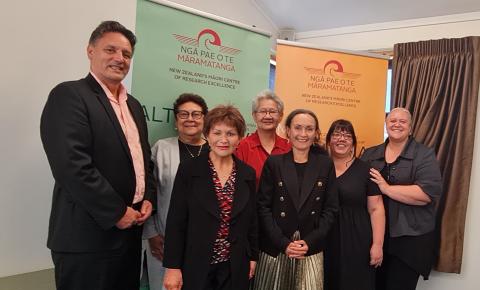
NPM was thrilled to extend a warm welcome to the directorship team from the newly funded ARC Centre of Excellence for Indigenous Futures. Hosted by the University of Queensland, the Centre is the first ever ARC Indigenous-led Centre of Excellence. The Centre aims to transform and improve the life chances of Indigenous Australians by utilising Indigenous knowledges to better understand and address the complex nature of Indigenous intergenerational inequity.
We look forward to walking alongside our friends and colleagues from Te Whenua Moemoeā in coming years.
From left to right: Professor Brendan Hokowhitu (Director), Distinguished Professor Aileen Moreton-Robinson (Deputy Director and Law and Justice theme leader), Professor Brownyn Fredericks (Education and Economics Theme Leader), Linda Waimarie Nikora, Tahu Kukutai, Assc. Professor Crystal McKinnon (Victoria Node Leader and Law and Justice co-theme Leader), Marie-Chanel Berghan.
Kōrero Tawhito · Archive
Future Pathways Green Paper submission from Te Pūtahitanga collective of Māori scientists and researchers
Te Pūtahitanga - a nationwide collective of Māori scientists and researchers responded to the Ministry of Business, Innovation & Employment's (MBIE) Te Ara Paerangi - Future Pathways Green Paper - a multi-year programme focused on the future of New Zealand’s research system. The programme seeks to start an open and wide-ranging conversation on a range of issues facing the research system, how these issues might be addressed, and how to take advantage of emerging opportunities.
Te Pūtahitanga came together to shape a collective response to MBIE's Te Ara Paerangi consultation process.
Te Pūtahitanga is a collective of Māori scientists and researchers working in universities, Crown Research Institutes (CRIs), Te Pūkenga, Independent Research Organisations, Wānanga, businesses, and Not For Profits, across communities and within diverse Māori entities. We encompass all career stages, from senior RSI leaders and managers, to early career researchers (ECRs). Many of us have prior experience of collaboration to progress Māori aspirations for RSI and have deep experience of what works for our communities.
Rauika Māngai (National Science Challenges) Response
A response to the issues raised in Te Ara Paerangi Future Pathways green paper was also made on behalf of Rauika Māngai, Māori leaders across the 11 National Science Challenges and Ngā Pae o te Māramatanga. Responses were developed through discussions within and across Challenges, and wānanga of kairangahau Māori across the science sector.
Kia Puawai Symposium 21 April 2022
The University of Canterbury Mauriora Platform Research Team, in conjunction with Ngā Pae o te Māramatanga is hosting a one-day, online symposium to celebrate the culmination of two and a half years research by the Te Rū Rangahau team
This is an open invitation to attend the Kia Puāwai – Māori Flourishing Symposium being held Thursday, 21 April 2022 from 09:00AM to 03:15PM
To register, follow the link: https://www.canterbury.ac.nz/events/active/uc-events/kia-puwai-symposium.html
The programme drew on seminal and recent research on supporting Māori to flourish, particularly centred on sustainable paradigms within different organisations. It examined baseline data and research on the supports, barriers and tensions for Māori to flourish in Aotearoa New Zealand. Our research strategy navigated cross-institutional and cross-disciplinary teams in order to develop significant outputs that created flexibility and changed the lenses adopted for future research to ‘foster the pathway of knowledge to strength, independence and growth for future generations’ (NPM, 2015). The strategy was to grow the skills and capabilities of emerging and mid-career researchers’ in original and high quality investigations and reporting.
SYMPOSIUM PROGRAMME
9.00am Mihi Whakatau (Formal welcome) – Dr Te Hurinui Clarke
9.15am Overview of Research Project: Practices of Sustenance - Collaborative exploration into the contours of wellness: Professor Angus Macfarlane
10.00am Ngā Pae o te Māramatanga: Address by Dr Mohi Rua
10:15am New Zealand Race Relations Commissioner: Meng Foon
10.30am Short Break
10.50am Commentary by Dr Megan Woods (Minister of Housing, Energy and Resources, and Research, Science and Innovation) and Rino Tirikatene (MP for Te Tai Tonga)
11.10am Keynote Address: Professor Melinda Webber
12.00pm Presentation by Emerging Researcher: Marie Gibson
12.20pm Address: Executive Director Māori, Pacific and Equity: (TBC)
12.30pm Break for Lunch
1.00pm Panel Discussion: Associate Professor Sonja Macfarlane, Hirone Waretini (NZ Police), Helen Leahy (Whānau Ora), Panapa Ehau (Rua Bioscience), and a Special Guest Dr Matiu Ratima will be the Panel Provocateur||
1.45pm Website Launch and Book Showcase: Website launch (Nathan Riki)
Kura Tapa Whā (Hayley Welch)
Living the Treaty (Emeritus Professor Ted Glynn)
Mana Whakatipu (Tā Mark Solomon)
Hikairo Schema Series (John Huria)
Ngā Hau e whā (Matiu Ratima and Catherine Montgomery)
3.00pm Closing Statements: Professor Gail Gillon
3.15pm Karakia
Māori Flourishing website: www.maoriflourishing.com
NPM Wānanga Paetukutuku, May 3rd, 2022
REGISTER HERE: Wānanga Paetukutuku | May 3rd, 1-2pm
In this quarterly webinar series NPM Co-Directors Professors Linda Waimarie Nikora & Tahu Kukutai will be leading a discussion on high quality research and evidence for interventions and policy.
For the first wānanga, Tahu will be taking a long term view over the pae (horizon) with some of NPM’s senior research leaders and discussing what needs to be done to realise the vision of flourishing Māori future.
- Prof Helen Moewaka Barnes - Pou Patai Puāwai
- Dr Shawn Awatere - Pou Patai Mauri
- Associate Professor Karyn Paringatai - Pou Patai Te Ao Māori
Date: Tuesday, May 3rd, 2022
Time: 1-2pm
"Ka Tangi te Pīpīwharauroa, Ko te Karere a Mahuru" - September 2015
On Wednesday 30th September Professor Rāwinia Higgins from Victoria University of Wellington, presented a professorial lecture on the current state of te reo Māori.
The whakataukī - Ka tangi te pīpīwharauroa, ko te karere a Mahuru - speaks to how the pīpīwharauroa’s call signals that spring has commenced and also conveniently provides an analogy that seems appropriate to the current state of te reo Māori.
It not only invites a consideration of the relationship between the pīpīwharauroa and Mahuru, but also for me, how the notion of ‘tangi’ might be thought to echo in the struggle for Māori language revitalisation.
In Mahuru (September) 1972 the Māori language petition was placed on the steps of Parliament, precipitating events such as Māori language Day that eventually led to Māori language week.
In 2015, Mahuru has also been a reo Māori month in which a number of people have taken up the challenge to speak only te reo Māori. Social media provides us with an ideal platform to observe the journey of these Māori language aficionados as they confront opportunities and challenges in our ‘doggedly monolingual’ environment.
Will these Māori language enthusiasts be like the pīpīwharauroa, forcing themselves into the nests of others in order to survive? What are the best strategies to ensure the survival of the language?
These questions and others will be reflected on as we contemplate te reo Māori and its future direction.
Professor Rāwinia Higgins is Head of School for Te Kawa a Māui in 2014. In July 2014 she became Professor of Māori Studies and Iho Ngārahu Māori (Assistant Vice Chancellor Māori Research). She was joint Principle Investigator of Te Kura Roa, a 3-year, $1.5m Ngā Pae o Te Māramatanga Pae Tawhiti Initiative for Te Reo Māori and currently leads the Whaihua—Community Responsiveness project in collaboration with Te Ataarangi and Te Kōhanga Reo. Her research interests include te reo Māori, Māori language literature, Māori language planning and policy, Tikanga Māori and Moko.
Enquiries
Ngā pukapuka · Publications 43
See all 43 →
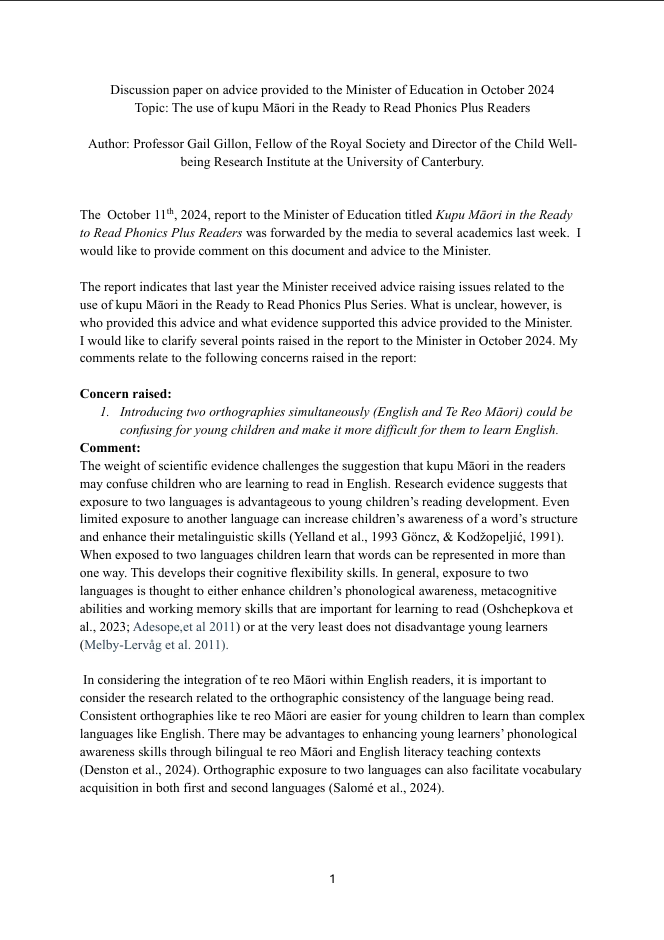
Discussion paper on advice provided to the Minister of Education in October 2024
Discussion paper on advice provided to the Minister of Education in October 2024 on the use of kupu Māori in the Ready to Read Phonics Plus Readers.
Author: Professor Gail Gillon, Fellow of the Royal Society and Director of the Child Well being Research Institute at the University of Canterbury.
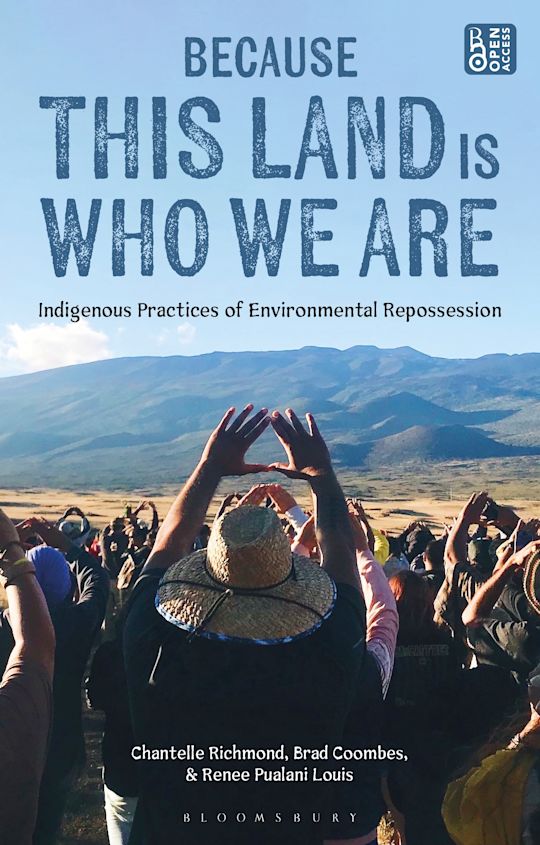
Because This Land is Who We Are: Indigenous Practices of Environmental Repossession
The Politics of Urban Potentiality
Challenging Anthropocene Ontology Modernity, Ecology and Indigenous Complexities
Archaeologies of Indigenous Presence
Bad Medicine: Settler Colonialism and the Institutionalization of American Indians
Ngā pūtea · Grants 10
See all 10 →Borrin
ClosedBorrin Foundation – Ngā Pae o te Māramatanga Postgraduate Scholarship
Closed 9 Sep 2024
Applications for this scholarship are open. Applications close at 12pm, Monday 9 September 2024.
Pool of funding available: $80,000 (the pool may be awarded to one scholar or split between two)
The Borrin Foundation wishes to contribute to increasing Māori postgraduate scholarship in law.
We invite proposals from Māori law graduates who wish to obtain a postgraduate degree in law overseas or domestically.
Ngā Pae o te Māramatanga, New Zealand’s Māori Centre of Research Excellence will provide support and manaakitanga to the successful candidate including via Te Kupenga o MAI (The Māori and Indigenous scholar network).
Eligibility
- Māori LLB graduate from a New Zealand institution who wishes to advance their law studies.
- Strong academic record.
- Connection to Te Ao Māori.
- Future potential for Māori leadership in legal development and the legal profession.
How it would work
The aim of the scholarship is to support a Māori scholar to pursue a post-graduate degree in law at a New Zealand university or at an overseas institution (any jurisdiction) including multi-year degree programmes.
Funding can be used for costs such as course fees, living expenses, and economy class airfares.
Application dates
Applications open once a year in August. The dates for the current application round are:
Applications open: 12 August 2024
Applications close: 9 September 2024
How to apply
The grant application process is handled by the Borrin Foundation on their website.
To apply you need to go to the Borrin Foundation website to download and prepare all your paperwork. then submit this information through the online application on the Borrin Foundation website.
Whakaaweawe
ClosedWhakaaweawe Grant Round 2026
Files
2026 round opening July (date TBC)
Application and guideline info coming soon
Ngā Pae o te Māramatanga (NPM) is inviting applications for our 2026 Whakaaweawe Impact and Transformation Grants.
PURPOSE
NPM Whakaaweawe Impact and Transformation Grants support Māori researchers employed at a NPM partner entity to achieve research outcomes and knowledge sharing pathways that harness connectedness and promote research uptake and impact.
SUPPORTED ACTIVITIES
The types of activities supported by this grant might include individual or collective outputs including artistic works, performances, and creative designs, policies, or processes. They might also include activities that lead to scholarly books, journal articles, impact and/or policy briefs and other nationally and internationally published outputs and presentations that offer new, recovered, or reinterpreted knowledge.
Examples of what the grant might be used for including: creating digital assets including film, photography, infographics, illustrations; creating interactive experiences such as board games and exhibitions; creating performative or artistic articulations of research findings such as film and compositions; publication and final editing costs; Open Access expenses; hosting or attending an in-person event, hui, wānanga or conference.
Successful applicants in the past have used this grant to support research outputs that have included books, journal articles, free online resources, app development, compositions (e.g. waiata and haka), translation of existing work into te reo Māori for publication, and to attend and present research at conferences.
ELIGIBILITY
The lead applicant must be a Māori researcher employed at an NPM partner entity.
DURATION
All projects need to be completed within 12 months to meet NPM contract obligations. All funding should be spent by 30 June 2027, unless otherwise agreed with NPM.
VALUE
We expect to support a mix of 10-15 projects, valued up to $3,000 and larger projects up to $7,000, from a total funding pool of $50,000 NZD.
For applicants seeking support to present an accepted, peer-reviewed paper at an academic conference, the maximum that may be applied for is $2,500 and may be used to cover registration at online or in-person conferences, travel and accommodation.
CLOSING DATE
2026 round opening July (date TBC). Application and guideline info coming soon.
NPM Futures
ClosedMāori Futures Programme New Horizons Summer Internships 2025/2026 - Internship Applications
Closed 8 Sep 2025
Files
Opening and Closing Dates
Wednesday, August 20, 2025, to Monday, September 8, 2025 - 5:00pm
The Ngā Pae o te Māramatanga Māori (NPM) Futures Programme supports promising Māori students as a means to growing an expert and capable Māori researcher workforce for Aotearoa New Zealand. The programme is about growing tomorrow’s Māori research leaders who are able to set and pursue strong research directions to produce knowledge, foundational to building a flourishing future for Māori. Our internship programme is a successful and long-standing strategy that NPM uses to achieve this goal. Some of our earlier interns have pursued doctoral and post-doctoral studies; joined impactful research teams in the National Science Challenges; found academic or professional research roles in organisations like Universities and Crown Research Institutions; or founded their own research consultancies.
< CLICK TO DOWNLOAD APPLICATION FILES & TEMPLATES >
PURPOSE
The New Horizons internship programme is for Māori students interested in pursuing a career in research. The award will provide assistance to Māori students enrolled at a NPM tertiary education partner entity to gain research experience and increase their research skills. The student will work under the supervision and guidance of an excellent NPM Māori researcher based at any NPM partner entity. The student will complete research activities that align to the NPM Matakitenga research programme and contribute to the mission of NPM which is to create the foundations for flourishing Māori futures. Interns will participate in the online NPM Māori Futures support programme during the tenure of their award and are actively encouraged to participate in broader NPM activities as appropriate.
TERM
The internship programme will run over 10 weeks, beginning the week of 1 Dec 2025 – 16 Feb 2026 summer period.
STUDENT INTERN ELIGIBILITY
The award is for pre-doctoral senior undergraduate or post graduate Māori students enrolled in 2025 at an NPM tertiary education partner entity. They can be enrolled in upper-level undergraduate (Bachelor) or post-graduate (Master) degree programmes. Students may be enrolled to complete a senior undergraduate special topic, post graduate dissertation or thesis as part of their internship. The award is intended for students who are genuinely interested in advancing their skills and capacity in Indigenous development and research. Students must be available to fully engage in the internship experience, and are not employed, completing summer school or professional development activities for more than 10 hours per week. To be eligible for this award, students must not be holding any other internship award from any source.
VALUE
$7,500 NZD per award
WHAT INTERNSHIP OPPORTUNITIES ARE THERE?
For a full list of the available projects please download the 25-26 NPFNH Internship Projects file. Full descriptions of the opportunities available, including the supervising researcher, their institution, the project descriptor, objectives and work programme are outlined.
Internships are competitive and for this reason we ask student applicants to indicate their first, second and third choice of internship projects. Once we receive student applications, we determine the best match between advertised project and student interests. We then recommend the best match of student(s) to the supervising researcher and confirm student choices. Once confirmed, the intern is expected to begin their internship any time after the conclusion of the university exam period but no later than the week of 1 December 2025.
WHAT INFORMATION IS REQUIRED?
- A completed application form including statements of interest for selected projects.
- CV
- Academic transcript that includes recent grades received in your current and/or previous degree.
- Letter of reference from an academic staff member
FAQ
Q. I am interested in the Raumati Internships, but I am not enrolled at one of the NPM partner entities, can I still apply?
A. Unfortunately, no. To be eligible to apply you must be enrolled at one of our NPM partner entities.
Q. I will be working part-time over the summer, can I still apply for a Raumati Internship?
A. As long as you will not be working more than 10 hours per week and will be available to fully participate in the internship experience you can apply.
Q.I am only interested in one of the Raumati projects advertised, can I apply for one project, or do I have to select three projects?
A. You can apply for only one project, but we would strongly encourage you to select more than one to increase your chances of being selected.
Q. I am working on my application and see we have to include an academic transcript as part of the application-does this need to be an official transcript record?
A. We will accept a PDF of your previous grades, we do not require an official transcript record.
Q. I am preparing my application and see we need to include a letter of support from an academic staff member. I do not know any academic staff members, could I ask someone else to write a letter of support?
A. Letters of support are a critical part of the application, and we prefer these to be from academic staff members. We will consider other letters of support, but these will need to detail your abilities, experience, work ethic and commitment.
Q. I have submitted my Raumati Internship application, when will I find out if my application was successful?
A. We will endeavour to let all student applicants by the 14th of October 2025. All applications are screened for eligibility, and on a case-by-case basis a student applicant will be recommended to the project supervisor. Once the project supervisor has confirmed their preferred applicant, we let that applicant know as soon as possible. These processes can take some time, and sometimes there are delays beyond our control. We appreciate your patience as we complete the process.
Q. I have applied for a Raumati Internship but haven’t heard anything yet. One of my friends also applied and they have received an internship award letter-does this mean my application was unsuccessful?
A. Not necessarily. We recommend student applicants to project supervisors on a case-by-case basis. We work closely with the project supervisor to make sure the student applicants are the best match possible. Once we have received confirmation from project supervisors, that student is advised as soon as possible. These processes take time, and we appreciate your patience as we work through this process.
Q. If I am awarded an Raumati internship, when will I receive the grant payment?
A. The Raumati internship grant is paid in two instalments. The first instalment will be processed for payment in the first week of the NPM Raumati Internship programme, and the final instalment will be processed for payment in the final week of the programme.
INFORMATION AND DOCUMENTS PROVIDED
- 25-26 NPM Māori Futures Programme New Horizons Student Internship Application form-for completion and submission.
- 25-26 NPMNH Internship Projects file-for selection of projects
- 25-26 NPFNH Internship General Regulations-for your information.
CONTACT: research@maramatanga.ac.nz
NPM Futures
OpenMāori Futures Programme New Horizons Summer Internships 2026/2027 - Project Applications
Applications close 19 Jun 2026
Files
CALL FOR INTERNSHIP PROJECT PROPOSALS FROM SUPERVISING NPM RESEARCHERS
The Ngā Pae o te Māramatanga Māori (NPM) Futures Programme supports promising Māori students interested in pursuing a career in research to work under the mentorship of a senior Māori researcher.
The New Horizons Summer Internships award assists Māori students enrolled at a NPM tertiary education partner entity to work under the supervision and guidance of a NPM Māori researcher based at any NPM partner entity, in order to gain research experience and increase their research skills. Interns will participate in the online NPM Māori Futures programme during the tenure of their award to support their research skills development.
The Borrin Legal Summer Internships invite proposals from legal scholars based at our partner entities to host a Māori summer research intern. This internship supports Māori students with a strong interest in law, justice, and social equity to develop advanced research skills under the guidance of an expert Māori legal researcher. Projects must have a strong legal focus, ideally addressing justice, rights, equity, or the role of law in Aotearoa New Zealand; align with the Borrin Foundation’s vision for a just, inclusive, and rights-respecting society. Contribute to NPM’s mission to create the foundations for flourishing Māori futures.
< CLICK TO DOWNLOAD APPLICATION FILES & TEMPLATES >
SUPERVISOR PROJECT ELIGIBILITY
Any NPM researcher (supervisor) based at a NPM Partner entity can submit a proposal to host and supervise an intern. Projects must demonstrate scholarly excellence, societal relevance, and alignment to the NPM Matakitenga research programme.
INTERN ELIGIBILITY
Māori pre-doctoral students enrolled at a NPM tertiary education partner entity in 2026 who are genuinely interested in advancing their skills in Indigenous development and research.
Students can be enrolled in upper-level undergraduate (Bachelor) or post-graduate (Master) degree programmes.
DURATION
10 internships will be available for the December 2027 - February 2027 summer period.
VALUE
$7,500 NZD per award, paid in two instalments directly to the intern.
CLOSING DATE
Supervisor internship project applications are due Friday 19 June 2026, 5.00pm
APPLY ONLINE
Please use the link at the bottom of this page when it becomes available.
CONTACT
APPLICATION PROCESS
There are three stages to developing and awarding an internship.
1. Call for Internship proposals from NPM researchers
The internship proposal is for a research activity usually associated with a larger project or
programme of research being led by the applying researcher. It is not recommended that a
student conceive and conduct their own research project due to the short period of the internship. The focus of an internship research activity should be aligned with the NPM Matakitenga research framework.
A research activity might include: a literature review, designing a survey, assisting with data collection, analysis of an existing data set, or engaging in a collaborative academic writing exercise. The proposed research activity should be achievable within a ten-week period during the university summer holiday break. The researcher who submits a proposal will provide supervision and support to the intern. Where students will assist with data collection, ethical approval must be received prior to the internship commencing, with a copy submitted to NPM.
2. Internship proposal selection
Following receipt of proposals, suitable internships will be advertised to Māori students on the Ngā Pae o te Māramatanga website and through social media channels from 29 June 2025.
3. Students apply for available internships
Any student enrolled at an NPM tertiary education partner entity may apply for an advertised summer internship. Internships are competitive and for this reason we ask student applicants to indicate their first, second and third choice of internship projects.
Once we receive student applications, we determine the best match between advertised project and student interests. We then recommend the best match of student(s) to the supervising researcher. Once confirmed, the intern is expected to begin their internship any time after the conclusion of the university exam period but no later than the week starting 30 November 2026.
For Māori Doctoral Students
ClosedMāori Futures Programme PhD Scholarships
Closed 10 Nov 2025
Files
2027 PhD Scholarship Applications
2027 PhD Scholarship round opening later this year (date TBC). Application information and guidelines coming soon.
The Ngā Pae o te Māramatanga Māori (NPM) Futures Programme supports promising Māori students at the senior undergraduate, postgraduate, and doctoral levels, aiming to grow a skilled Māori researcher workforce for Aotearoa New Zealand. The programme focuses on developing the next generation of Māori research leaders who can set and pursue impactful research that contributes to building a flourishing future for Māori. Our PhD Scholarship grant is a key strategy in achieving this goal. Many of our past recipients have successfully completed doctoral and post-doctoral studies, joined influential research teams, taken on academic or professional research roles in universities and Crown Research Institutions, or started their own research consultancies. NPM’s programme is a proven and excellent pathway for fostering Māori research talent.
< CLICK TO DOWNLOAD APPLICATION FILES & TEMPLATES >
PURPOSE
The NPM PhD Scholarship is for Māori students enrolled in a PhD program at any NPM Partner institution. The scholarship provides financial assistance through a non-taxable stipend and ongoing support through the NPM Māori Futures Programme. Recipients will progress their PhD research in alignment with the NPM Matakitenga framework and contribute to NPM's mission to create foundations for flourishing Māori futures. All recipients are expected to participate in NPM professional excellence activities, Te Kupenga o MAI, the biennial International Indigenous Research Conference, and NPM researcher wānanga. Successful applicants will join a high-impact, multi-institutional team of Māori researchers across Aotearoa, all working towards transformative change for a better future.
ELIGIBILITY
All applicants must be a high-achieving Māori PhD student currently enrolled at an NPM partner institution undertaking research that aligns with the NPM Matakitenga research framework (available here). The NPM PhD Doctoral Scholarship cannot be held concurrently with any New Zealand University-named doctoral scholarship. Applicants holding such scholarships are ineligible until their current award concludes. NPM award holders must promptly notify NPM of any additional grants or scholarships, and NPM reserves the right to modify the scholarship's conditions at its discretion.
DURATION
The scholarship is for a duration of two years with the expected Doctoral thesis submission date being on or before 30 September 2028.
VALUE
The scholarship provides a stipend of $36,050 per year, plus $9,785 for professional development support, for a duration of two years. Successful applicants will receive a complimentary registration for the NPM Biennial International Indigenous Research Conference and NPM professional excellence activities. In this round, we aim to support a total of five PhD scholarship awards.
CLOSING DATE
2027 PhD Scholarship round opening later this year (date TBC). Application information and guidelines coming soon.
WHAT INFORMATION IS REQUIRED?
A. Cover Letter (Word doc)*
B. Completed NPM PhD Scholarship Application Form (Word doc)
C1. Doctoral Registration Summary and
C2. Academic Transcript (PDF)
D. Curriculum Vitae (PDF using the cv template provided)
E. Letter of reference from an academic staff member
*Your cover letter should include the following:
- Your commitment to working in the Māori world and your intended career trajectory.
- Previous NPM activities you have engaged in, in particular your participation and contribution to Te Kupenga o MAI.
- What the scholarship would mean to you, the difference it will make and how the scholarship would support your PhD.
HOW TO APPLY
Applications must be submitted through the NPM online application portal
(Use the "Apply Online" link below).
CONTACT: research@maramatanga.ac.nz
Research
ClosedNgā Pae o te Māramatanga Matakitenga Research Round
Closed 28 Apr 2026
Files
Purpose
Ngā Pae o te Māramatanga (NPM) is Aotearoa’s only Māori Centre of Research Excellence (CoRE) that is funded by New Zealand’s Tertiary Education Commission and hosted by The University of Auckland. Our mission is to nurture Māori researchers to undertake excellent, impactful research that accelerates flourishing Māori futures. Our research is focused on bringing positive change and transformation to Māori, the nation, and the global Indigenous community. The NPM Matakitenga research fund supports research projects that contribute to our overall mission and specific outcomes in our Matakitenga Research Framework (view the framework here).
Matakitenga alignment
Research applications must align with the priority outcomes in our Matakitenga Research Framework (see Appendix 1 in the application form). This year, priority will be given to Pae Ahurei applications, particularly community-orientated projects. Applications for the other Pae (Tawhiti, Ora and Auaha) will be considered. We invite applications from new and emerging researchers.
Eligibility
- The lead applicant must be a Māori researcher employed at a NPM partner entity (The full list of NPM partner entities can be accessed here).
- The wider team must include at least two NPM partners,and can additionally include community-based partners.
Requirements
- Projects must be completed as per the research plan, including meeting NPM reporting requirements.
- Ethics approvals must be submitted to NPM.
- Projects must acknowledge the support received by NPM.
- The lead applicant should expect to participate in at least one NPM Wānanga (Paetukutuku / TTT Hui-ā-Tau / Rangahau).
Duration
The application outcomes will be notified by 30 June 2026. Applicants must be prepared to spend their fully allocated budget by 31 December 2027.
Value
We expect to support projects valued between $10,000-$60,000 NZD, from a total funding pool of $500,000 NZD. Proposals for full projects and to seed or scope research are both eligible.
Closing date
Tuesday 28 April 5:00pm
How to apply
Download and complete the application documents below. Applications are to be submitted through the NPM application portal. The online portal will be open on the Tuesday 24 March 2026 and can be accessed here.
Information webinar
The NPM Pou Matarua Co-Directors will facilitate an information webinar on Thursday 9 April 2026, 1:30pm. Please register here.
Contact
For application queries please email: research@maramatanga.ac.nz.
Ngā ataata · Videos 394
See all 394 →Te Arotahi 11
See all 11 →
Te Arotahi Paper
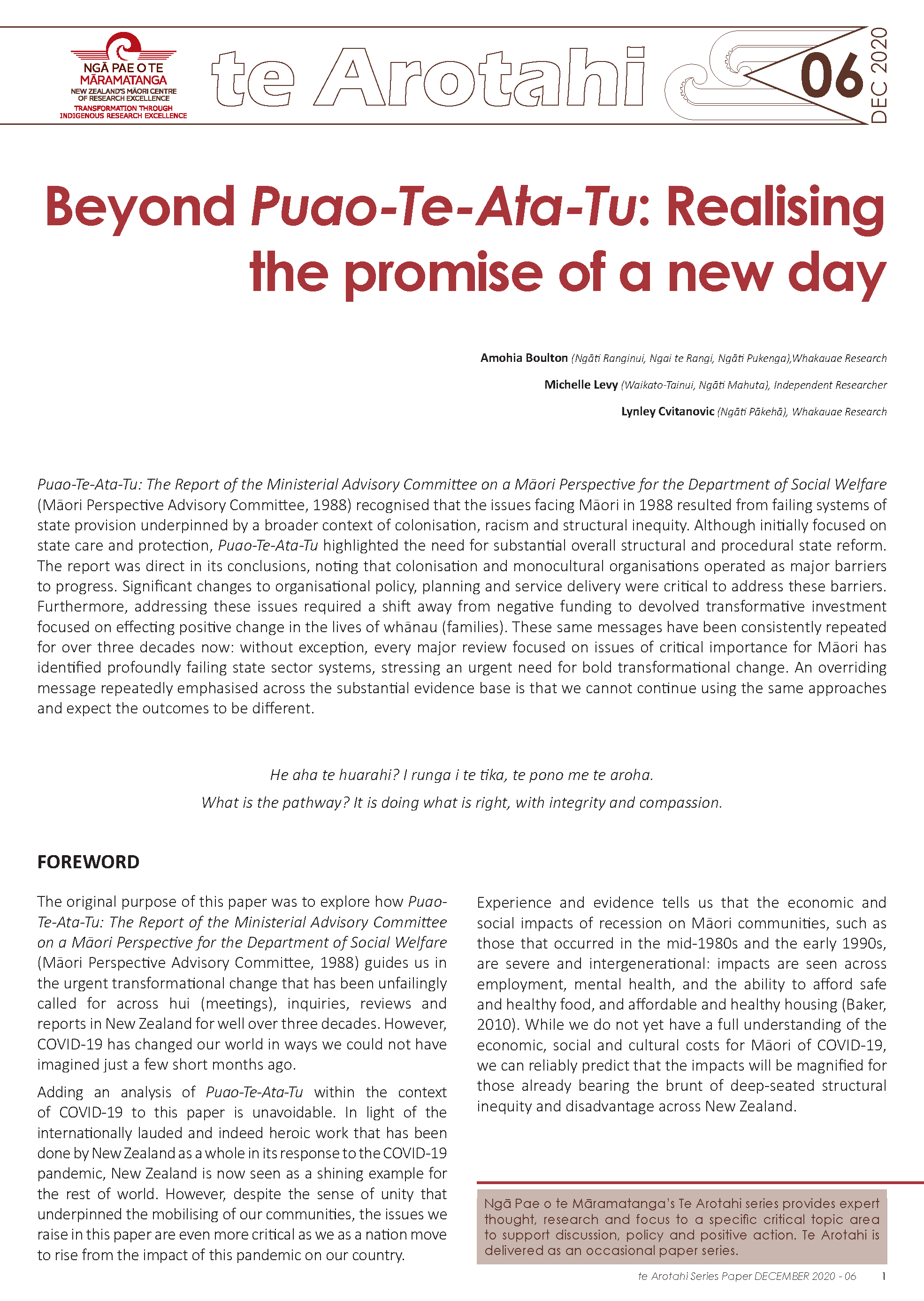
Aropū Paper, Te Arotahi Series January 2026 No.11
Benefits of a PhD for Māori and Pacific Graduates
Te Arotahi Paper
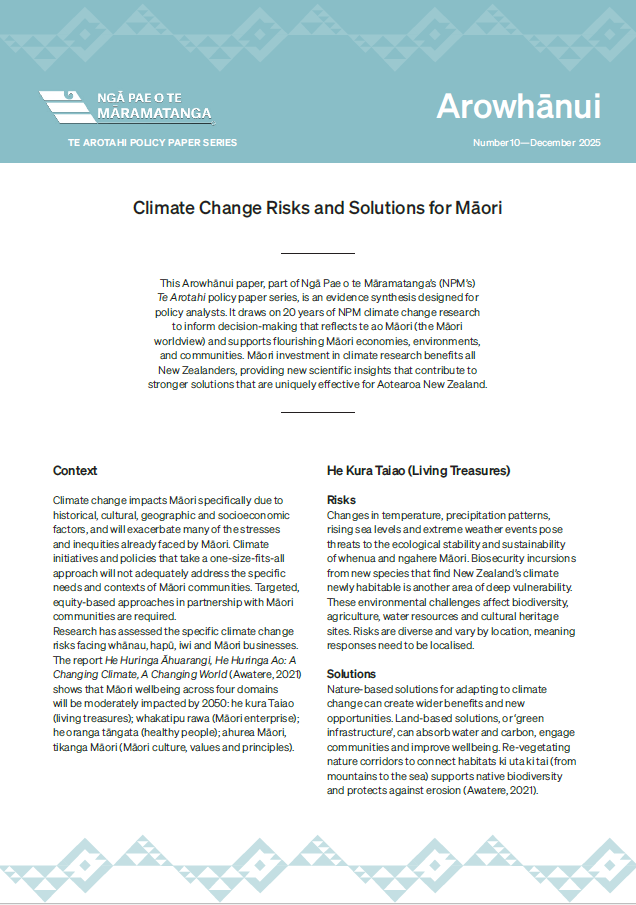
Arowhānui Paper, Te Arotahi Series December 2025 No.10
Climate Change Risks and Solutions for Māori
Te Arotahi Paper
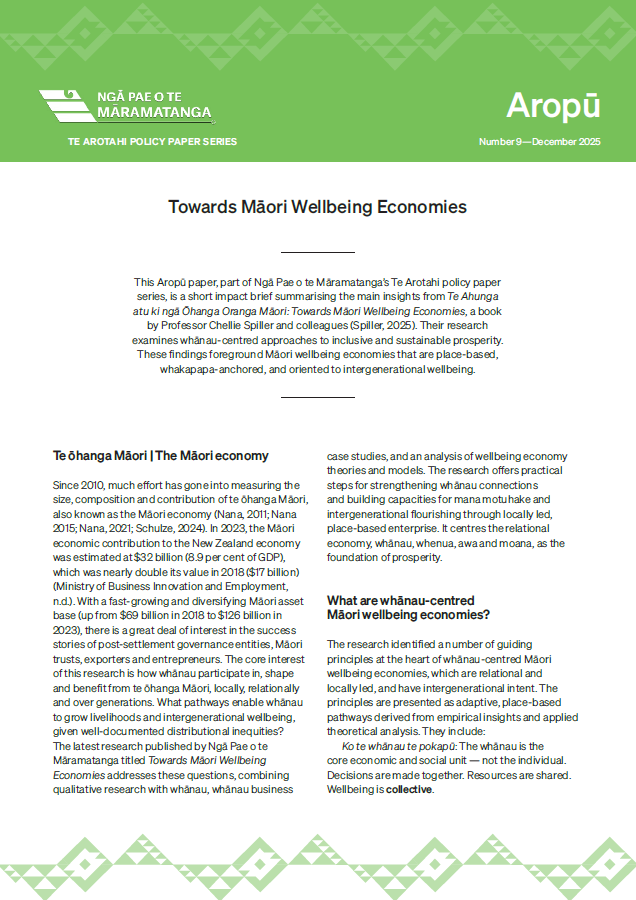
Aropū Paper, Te Arotahi Series December 2025 No. 9
Towards Māori Wellbeing Economies
Te Arotahi Paper
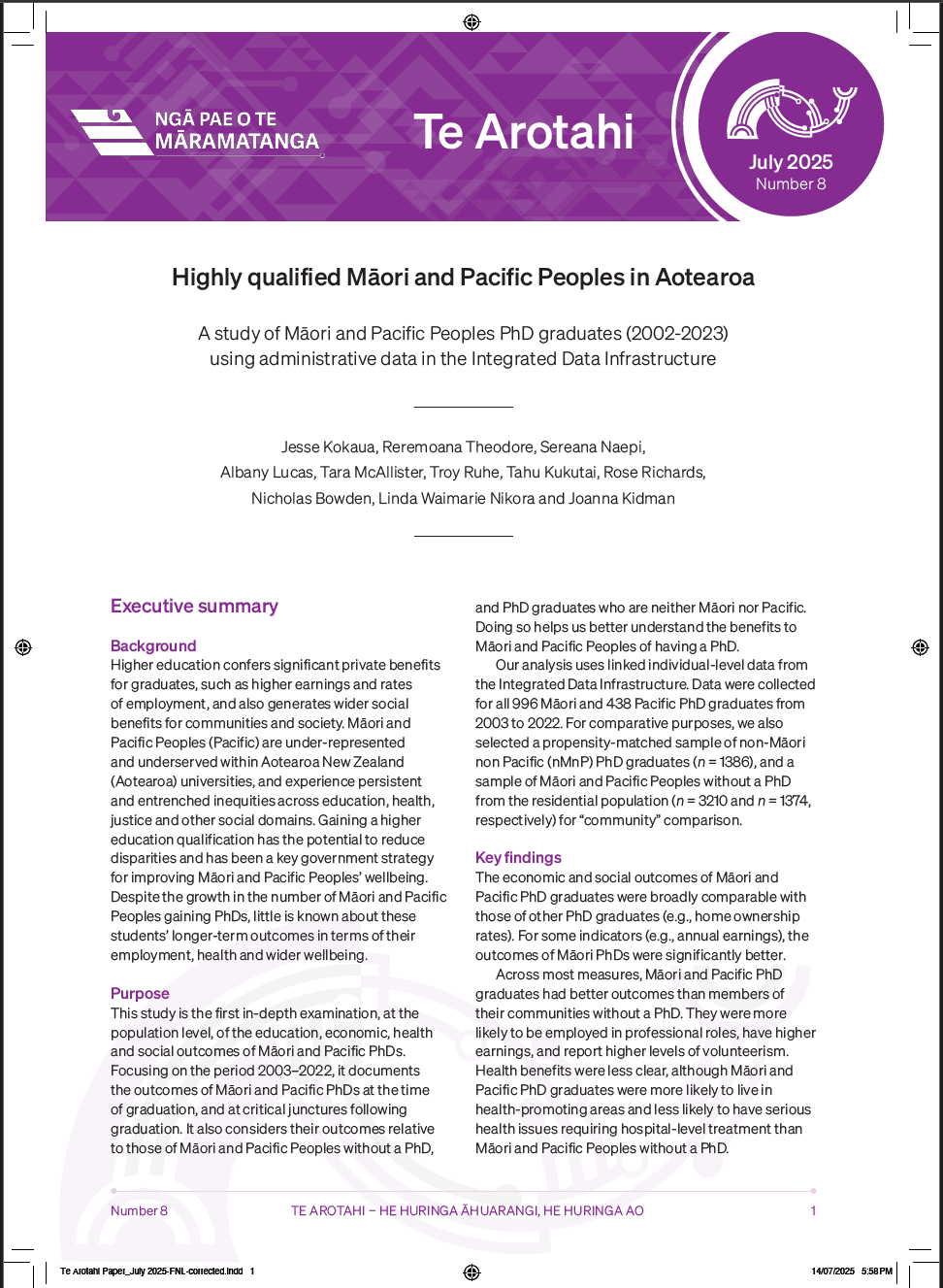
Te Arotahi Paper Series July 2025 No. 08
Highly qualified Māori and Pacific Peoples in Aotearoa: A study of Māori and Pacific Peoples PhD graduates (2002-2023) using administrative data in the Integrated Data Infrastructure
Te Arotahi Paper
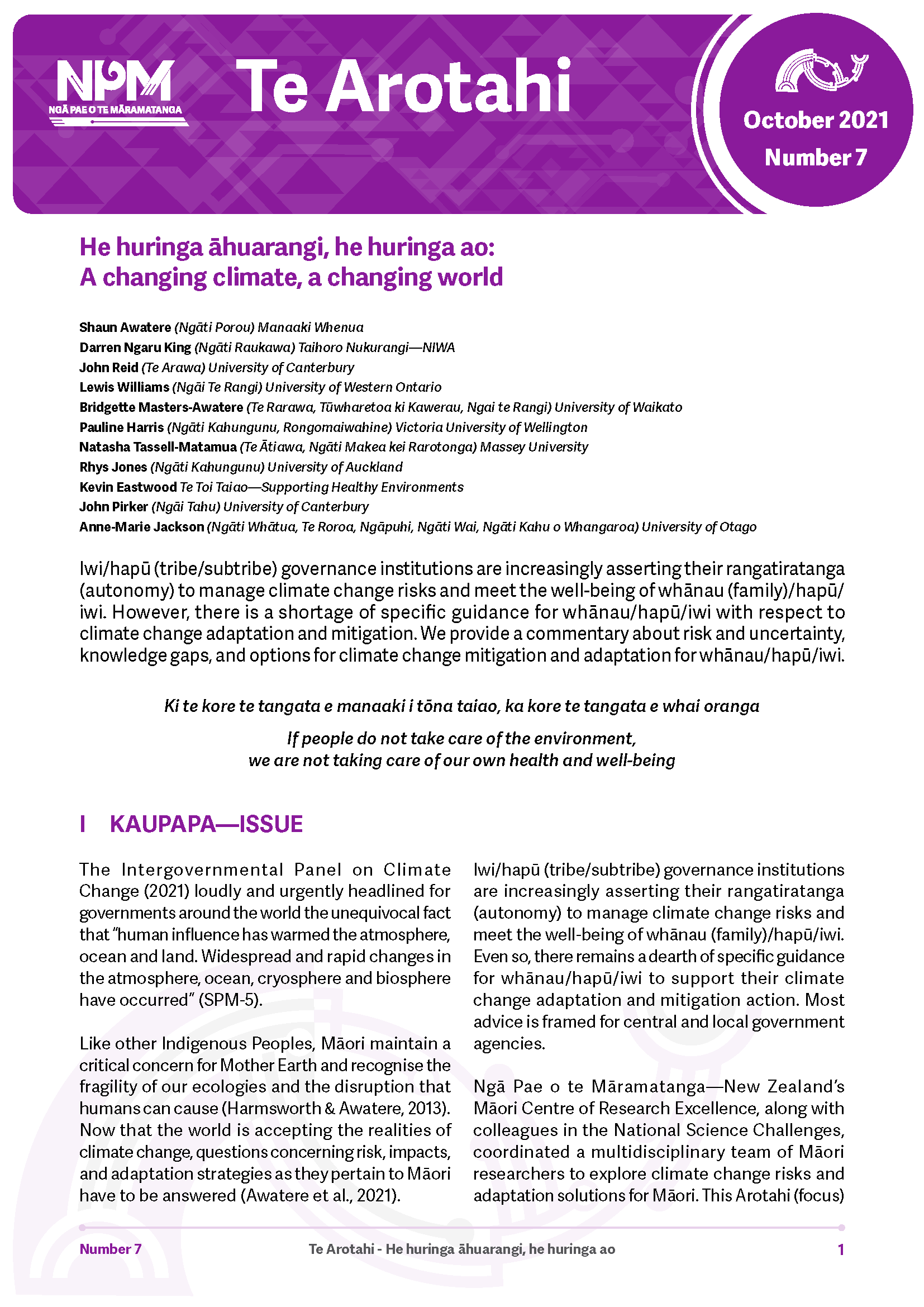
Te Arotahi Paper Series October 2021 No. 07
He huringa āhuarangi, he huringa ao: A changing climate, a changing world
Iwi/hapū (tribe/subtribe) governance institutions are increasingly asserting their rangatiratanga (autonomy) to manage climate change risks and meet the well-being of whānau (family)/hapū/ iwi. However, there is a shortage of specific guidance for whānau/hapū/iwi with respect to climate change adaptation and mitigation. We provide a commentary about risk and uncertainty, knowledge gaps, and options for climate change mitigation and adaptation for whānau/hapū/iwi.
Ngā pānui · Newsletters 49
See all 49 →E-pānui 55
See all 55 →Our PhD tauira never cease to inspire us. This e-pānui celebrates just two of the remarkable researchers in our whānau — a reminder of the creativity, depth, and purpose that defines scholarship at Ngā Pae o te Māramatanga.
Hine-Kaunuku (Morgana) Watson is breaking new ground in the gaming world, creating action-adventure games that centre wāhine Māori and bring Indigenous storytelling to a global audience.
Meanwhile, Amelia Blundell is weaving together personal history and rigorous research, with a PhD study focused on the kūmara plant which is the taonga at the heart of her whānau life and livelihood.
We were thrilled to partner with the Canadian Institute for Advanced Research (CIFAR) to host the first Radical ‘Interdisciplinarities: Indigenous Knowledges’ forum in Banff, Canada this month.
The forum gathered 40 Indigenous ECRs from Aotearoa, Australia, South Africa, Botswana, Norway, Greenland, Taiwan, India, Rapanui, Chile, Belize, Amazonia, Papua New Guinea, Samoa, Canada and the United States to develop interdisciplinary research collaborations around three main kaupapa.
As a national Centre of Research Excellence, we value the connections that we have to our 21 partners Te Tira Takimano who share our vision of research that empowers flourishing Māori futures.
This month we were grateful to be hosted on the whenua of Waikato-Tainui College for Research and Development for our two-day Kāhui Ārahi research impact wānanga.