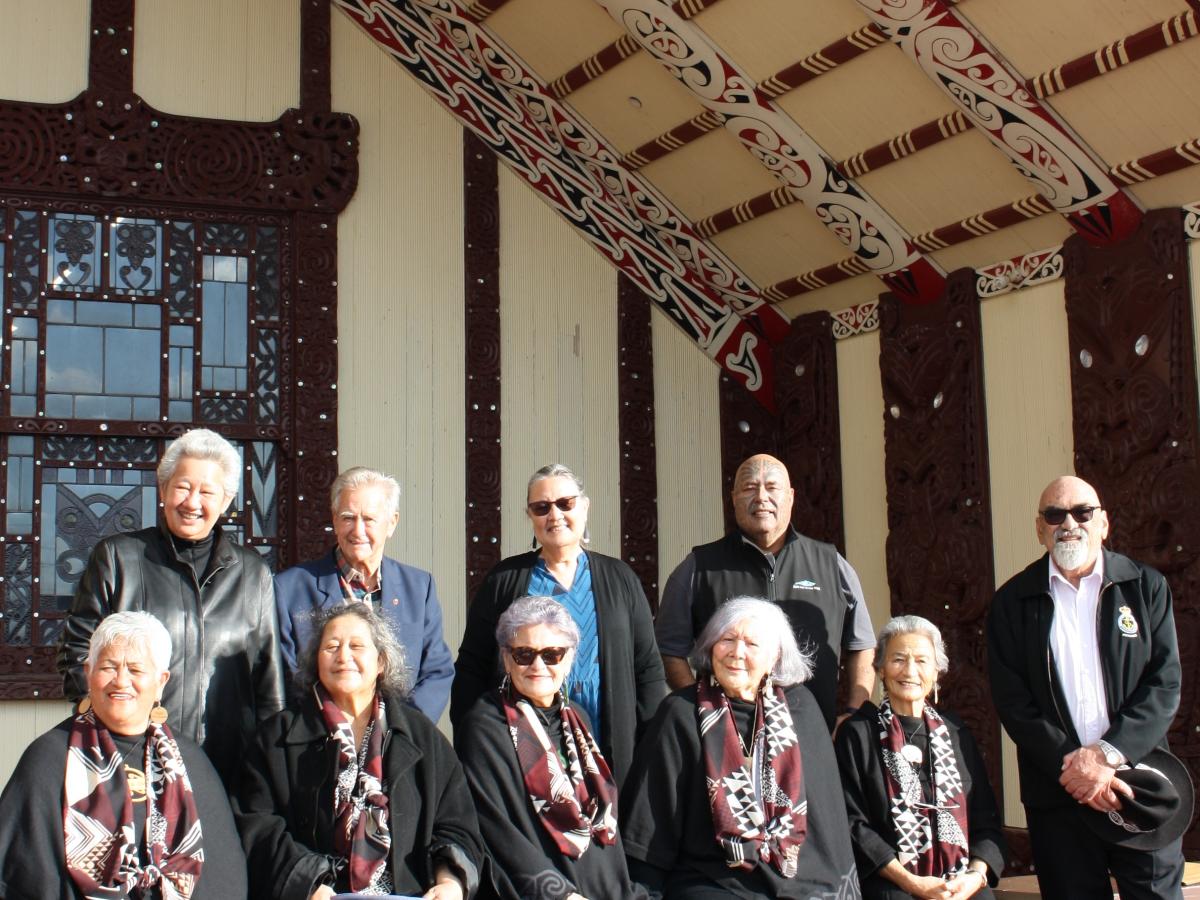
Kaumātua are the heart and soul of marae life and are often the ‘go to’ for guidance on kawa and tikanga. A new report written by NPM Fellow Dr Teorongonui (Josie) Keelan (Ngāti Porou, Ngāti Awa, Tūhoe) highlights just how busy kaumātua are in serving their people.
“You’ll find them at all events, no matter what size, standing up for their people. They are the kaikaranga, kaikōreo, mātanga and tohunga who attend the dawn ceremonies on freezing cold mornings, the tangi, marae events, they sit on trust boards, and they are often the interface between their people and government agencies,” says Teorongonui.
Supported by NPM and The Family Centre, the study was undertaken to better understand the lives of kaumātua: how they serve their communities; their roles and responsibilities; how they pass on their knowledge; their concerns and worries; and support needs. Rather than do a broad-brush national approach, Teorogonui limited her study to kaumātua from Ngāti Whakaue. She says the amount of time, energy and commitment they give to support their marae, hapū and iwi is huge. “They show up rain, hail or shine for their people, but unfortunately, they often do not feel acknowledged for their unwavering commitment," says Teorongonui.
It is this commitment that underpins what it means to be a kaumātua, with those in the study drawing a distinction between koeke (elderly person) and kaumātua. “They were very clear that not everyone has the right to call themselves kaumātua because not everyone dedicates themselves in service the way they do,” says Teorongonui.
Their concept of kaumātua included elderly Māori (both male and female) who were usually fluent speakers of te reo, well versed in waiata and stories of the iwi, knowledgeable of tikanga and and whakapapa (even if not fluent in te reo), had roles such as kaikōrero, kaikaranga, kaiwaiata and kaitautoko, and committed their time to represent the iwi. Not everyone possessed every skill but that did not matter so long as they were covered by the rōpū collectively.
A common theme from the study was the pride and joy that kaumātua felt about their mokopuna learning te reo. However, while te reo was flourishing, there were concerns that knowledge of tikanga and kawa was being lost. “People are not coming to their marae in the same numbers as before and kaumātua are worried about this. People are having tangi at home because of the expense, but the tikanga around tangi in the home is not clear, and that is a concern for kaumātua,” says Teorongonui.
She found that kaumātuatanga was a lifelong process of learning through observation and doing. The early steps tended to begin in the wharekai, learning the principles of awhi, tiaki and manaaki, later culminating in specific roles such as kaikaranga and kaikōrero.
Kaumātua felt that the ability to manaaki could diminish if whānau were not actively engaged with marae and developing the practical skills needed to organise and manaaki their own events like tangihanga and birthdays. “People don’t know how to plan menus or cook for hundreds of people, and they turn up to their own events expecting to be guests,” says Teorongonui.
She believes there are many opportunities to be creative and devise new ways to get whānau engaged with marae. Kaumātua saw much potential in marae-based wānanga, particularly for the transmission of tikanga and kawa.
Technology was less useful, with lack of access being a barrier for kaumātua. “They do not use email, preferring to read from a real piece of paper rather than from a screen. Because they are on fixed incomes, access to expensive computers, phones or the internet is not common, so they are using old phones that they can only call or text on. While it might change in the future, the current cohort of kaumātua are isolated by their lack of technological access and knowledge,” says Teorognonui.
Time spent with whānau was precious, with kaumātua saying that it gave them the most joy and meaning. “Almost every single one lived with whānau and that was something they liked, especially if there were mokopuna. Living with mokopuna gave them a sense of purpose and a reason for being,” says Teorongonui.
She believes there is a simple solution to make kaumātua feel more appreciated for the time and service they give to their people. “Younger generations need to just sit down and have a kōrero with them. Wānanga with them on a specific topic. Talk about the dreams they have for their whānau because they all have dreams about what they want for whānau. Then begin to work on those dreams – gather the rest of the whānau around to make their dreams come true.”
Ētahi atu · Other articles
The Aura of an Algorithm
From the flashing lights and clatter of a gaming arcade to the formality of a university lecture theatre, Dr Paul Brown’s journey into academia - like many Māori academics - hasn’t always followed the straightest line.
A statistician and lecturer at the University of Waikato, Paul (Ngāti Hikairo) says that when he first left Linwood College back in 2002 a career in academia, let alone mathematics, was unthinkable. He opted instead for managing a gaming arcade in his home city of Christchurch.
Six years later, Paul decided new beginnings were in order and he enrolled in a science degree at the University of Waikato. One maths paper was the catalyst he needed to put him on a life changing career trajectory.
Paul found his niche developing efficient algorithms for high-quality data analysis. He enjoyed the solitary nature of the work, solving problems with just a whiteboard and his wits. But his reputation as a statistician spread and other researchers came calling with requests to collaborate.
“It took me a while to get used to working with other people and getting my head around all the different fields and specialties, but I’ve come to realise this is how impactful research is done. Through these collaborations with applied data analysis, you can do powerful research and I like this aspect of my mahi,” he says.
The power of data and statistical modelling cannot be underestimated, says Paul. One example of this is a study of Police prosecution rates led by Professor Khylee Quince and Tā Kim Workman. The study involved working with the NZ Police to better understand how demographic factors, behaviours, and spatial and temporal patterns affect prosecution rates. Paul’s modelling found that Māori, on average, were 11% more likely to be prosecuted for the same offences as Pākehā, when all other things were equal. Gang members were also twice as likely as non-gang members to be prosecuted for the same offences when controlling for all other factors in the model (age, ethnicity, prior history) he says.
Such research is why data, statistics and modelling are important. “With this research we showed there was an inherent structural bias within the Police where they are prosecuting some communities far more than others. Now it is up to the Police to do more research to identify what procedures or systems are enabling this bias to occur, so they can work to change them,” says Paul.
In recent years Paul has expanded his expertise to include Indigenous data sovereignty research. One of his current projects involves developing algorithms to understand the global trade of Indigenous data. Paul aims to conceptualise how the cross-border trade of Indigenous data can be valued, including how such data can be identified, labelled, and ultimately valued economically. “There needs to be an awareness of the power of data in Māori communities so people can make informed decisions about what they are giving up when they give their data to big companies, and balance this with the benefits they might receive. Data sovereignty means being able to make these informed decisions,” he says.
Closer to home, Paul is working on a new NPM-funded project on Māori data sovereignty and governance in universities. Paul says while universities have been collecting Māori data for many decades, there is little transparency over what has been collected and where it is stored, in part because of a lack of Māori data governance.
A key problem that Paul is trying to tackle is data discoverability - developing algorithms to locate Māori data inside university data ecosystems. His collaborators Dr Kiri West (Waipapa Taumata Rau) and Dr Maree Sheehan (Te Wānanga o Aotearoa) are focusing on data governance and practical pathways for iwi, hapū and hapori to assert sovereignty over their data.
“Māori communities are being locked out of their own data, and we would like them to be aware of it so they can decide if they want to use it and who has responsibility for it. If they don’t want to do anything, kei te pai, as long as they are aware that it exists, and can make that decision for themselves.”
Data is tremendously valuable, says Paul, and with that comes responsibility. “I try to teach my students that as data analysts, you’ve got to make sure your work has integrity, you’ve got to do things the right way. Anyone that works with data needs to think about their responsibilities to stakeholders, to the people who the data is about, and to their profession to ensure the data is being handled and used appropriately.”
Hīnātore Sparks Research in Aquaculture
A childhood visit to glow worm caves left researcher Aymee Lewis (Ngāti Kahungungu ki Te Wairoa, Ngāti Rakaipaaka) with an enduring curiosity about creatures that glow in the dark. Today, Aymee’s fascination has not diminished, and the phenomenon of bioluminescence has become a focus of her PhD.
Bioluminescence is produced by naturally occurring chemical reactions in certain bacteria, fungi, insects and marine life. It’s the reason why some caves, waves and shadowy places appear to magically glow in the dark, she says. Despite the mystical appearance, Aymee’s research is hoping to spotlight more practical concerns.
Photobacterium spp. is the specific bacteria that causes glow, and Aymee is looking at whether it can be used in the aqua-culture industry. Specifically, her MAI Te Kupenga supported PhD looks at whether bioluminescence can be used in formulated fish food to improve the feeding of baby snapper.
Aymee says the aqua-culture industry has enlisted the help of scientists to help it diversify beyond farming shellfish and salmon. She says the benefit of raising farmed fish in the ocean is that it could relieve pressure on wild fish populations and help the industry become more sustainable.
Previous research shows young snapper are not thriving in hatcheries as they are unable to detect or respond to non-live food. The purpose of her research is to explore whether glowing bacteria can help attract baby snapper to fish food in hatcheries.
Her research focused specifically on the conditions bioluminescent bacteria need to create a strong glow; to find out if the bacteria can be used in live fish and non-live fish food; and to measure if baby snapper are attracted to food containing bioluminescence.
Her research results have been mixed. The research has generated rich data on bioluminescence — how it works, the conditions needed to produce a glow, and the development of glowing feeds — but current findings suggest baby snapper may not actually be attracted to bioluminescent food. Further analysis is still underway.
“What my research underscores is that nature is far more complex and as scientists, we are still determining what these factors are. So, I’m happy my research is helping move our knowledge base forward and other scientists can now use my results to continue experimenting,” says Aymee.
While economic outcomes are a focus, mātauranga has been foundational to her approach. According to Māori cosmology, Hīnātore is the entity of phosphorescent and bioluminescent light, the faint twinkle or glow seen in glowworms, and sea life. Aymee wanted to combine mātauranga with PhD research and went home to Wairoa to kōrero with whānau, hoping to gain a deeper understanding of Hīnātore.
“My whānau and community were very helpful, and having my kaumatua, Richard Niania, work alongside me, really helped me in this space. His knowledge, combined with disciplinary science, enabled me to have a much deeper and more reverent approach to the bacteria I work with.”
"We can’t live without bacteria. It’s everywhere in our lives, so for me as Māori scientist to have reverence for these organisms instead of just seeing them as a cloudy substance in a dish that I’m going to measure, it brings to life my values. These bacteria are amazing and magical, and I think if we take care of bacteria, they will take care of us. It is important to uphold the kaitiaki between us."
Exhibition:
Aymee is collaborating with Paraone Luiten-Apirana, Dan Hikuroa and Siouxsie Wiles for an art exhibition focusing on Hīnātore. The exhibition combines art and science and aims to awaken people’s curiosity about bioluminescence.
Where: Project Space, ELAM, University of Auckland
When: July 18, 10.30 am
Manukura: A Vision of Excellence
Manukura has been punching above its weight for over 20 years and now one of its own is digging into the reasons for its success. Keita Durie (Ngāti Kauwhata, Ngāti Raukawa, Rangitāne, Ngāi Te Rangi) has been undertaking research on the kura as part of doctoral study, supported by a NPM PhD scholarship.
Keita was in the second cohort of MANUKURA, beginning her secondary school journey in 2007. During this time, she saw first-hand how committed the school’s founders were to keeping the doors open and offering a different model of education for ākonga Māori.
Her whānau connections to the kura include her great-uncle, Tā Mason Durie, Uncle Nathan Durie, his wife Yvette Durie, and Uncle Rawiri Durie. All were visionaries who could see that a commitment to excellence was the way forward for Māori students in their high school years, she says.
With a role of only 12 students on the first day, the school opened its doors in 2005 under the mana of Aorangi Marae. Self-funded in the beginning, Keita remembers years of the school whānau delivering phone books and selling hāngī to keep the school operating.
“They were offered money from the Ministry of Education from a ‘Māori at risk’ fund, but this was rejected because the school did not want students to be framed in this way,” says Keita.
However, the lack of funding also had an upside and teachers had the freedom to deliver their curriculum in the way they knew worked, says Keita. Tā Mason's influential Māori health model Whare Tapa Whā was foundational to their approach to learning and ākonga well-being. Like many Māori education settings of the time, reo, tikanga and mātauranga Māori were embedded into learning, alongside two other important pou: elite sport and academic excellence.
“Aunty Yvette was an elite athlete herself, and she knew sport could be a catalyst to motivate ākonga. Uncle Nathan was devoted to teaching, and he was determined that students, particularly boys, would attain the educational excellence he knew they were capable of.”
Keita has interviewed former ākonga, whānau, staff, and school board trustees about those early years to better understand how the kura’s founding principles, teaching practices, and aspirations for ākonga contributed to long-term success.
Now raising their own families, former ākonga described the school’s focus on health and fitness, not only for themselves but also for their wider whānau as important to success. “Parents of former students told me their children’s healthy eating and commitment to fitness rubbed off on the wider whānau, who could see the value and began making changes themselves. One whānau entered a half marathon together as part of that commitment,” says Keita.
Keita heard a clear theme - that goal-setting support, elite sporting coaches, and specialist teachers all played a vital role in helping students reach their potential. They were treated as elite athletes with high-performance coaches and nutritionists to help attain goals." These insights resonated with Keita's own experience at MANUKURA. "From a young age, we had teachers who believed in us, cared for us, and walked alongside us the whole way,” she says.
While individual goals often changed over time, the process of goal setting helped develop habits that carried into adulthood, including how to organise themselves, develop strategies, think critically, and stay focused on what mattered to them.
While sport and academic excellence were important, Keita says her research found that one of the most significant things for former ākonga was the way the school affirmed who they were as Māori. At MANUKURA, gaining NCEA credits was seen as the baseline, not the ultimate and students were expected to go beyond that. “While there was a big focus on careers after high school, the bigger aim was growing successful adults who were proud to be Māori, who understood how to take care of their wellbeing, and who were engaged in their communities,” says Keita.
“Being proud to be Māori was huge. Many of those first ākonga now have their own children and many have chosen Māori educational pathways for them. The impact of the school has rippled out to the next generation. Parents of former students said the school was also transformational for them. Some were inspired to take te reo classes at wānanga. So the impact has not just been on one generation, but on three. There was also a strong theme of former ākonga wanting to give back to their communities,” she says.
Ultimately, Keita says, what stood out most was the gratitude former ākonga had for their teachers and for the way MANUKURA walked alongside them. “The kura’s holistic approach, with its focus on long-term wellbeing, excellence and being secure as Māori, helped set them up for lifelong success.