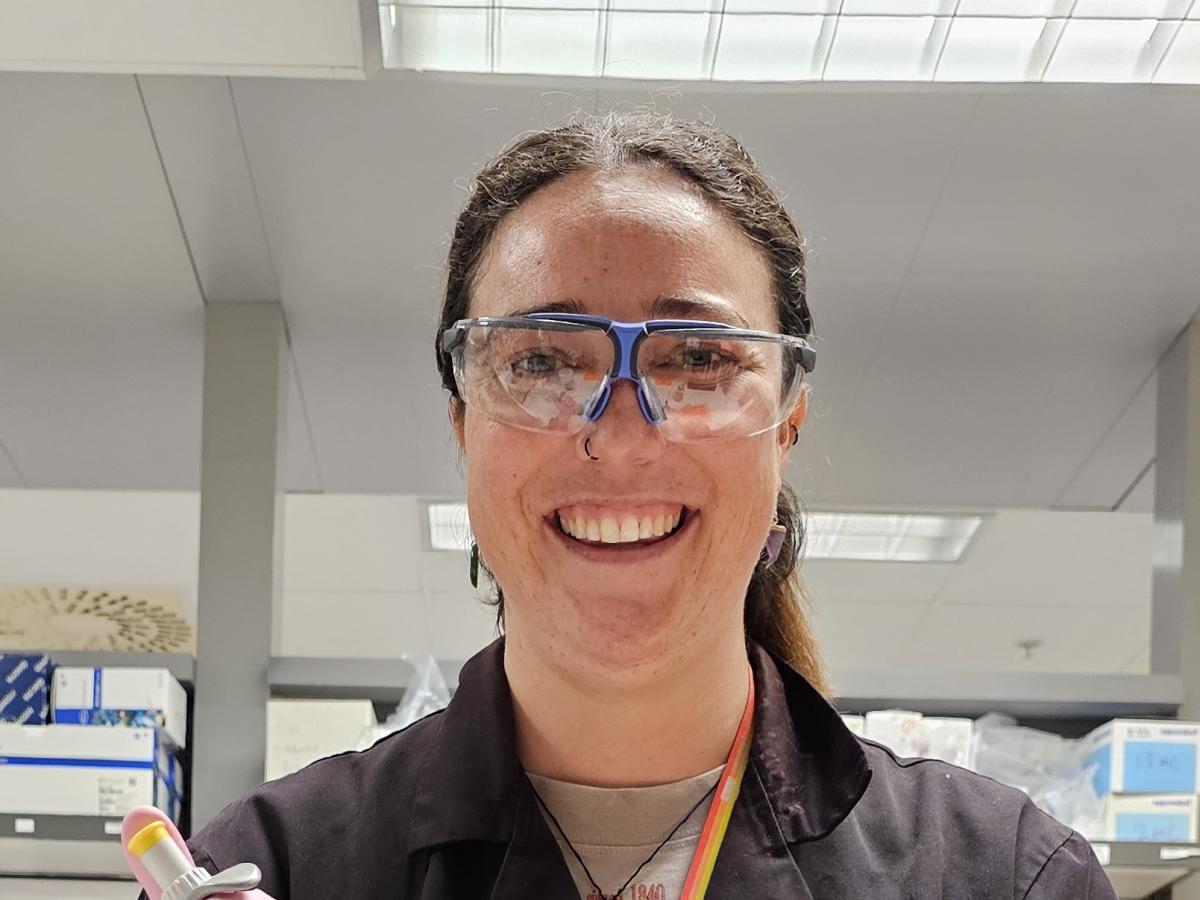
A childhood visit to glow worm caves left researcher Aymee Lewis (Ngāti Kahungungu ki Te Wairoa, Ngāti Rakaipaaka) with an enduring curiosity about creatures that glow in the dark. Today, Aymee’s fascination has not diminished, and the phenomenon of bioluminescence has become a focus of her PhD.
Bioluminescence is produced by naturally occurring chemical reactions in certain bacteria, fungi, insects and marine life. It’s the reason why some caves, waves and shadowy places appear to magically glow in the dark, she says. Despite the mystical appearance, Aymee’s research is hoping to spotlight more practical concerns.
Photobacterium spp. is the specific bacteria that causes glow, and Aymee is looking at whether it can be used in the aqua-culture industry. Specifically, her MAI Te Kupenga supported PhD looks at whether bioluminescence can be used in formulated fish food to improve the feeding of baby snapper.
Aymee says the aqua-culture industry has enlisted the help of scientists to help it diversify beyond farming shellfish and salmon. She says the benefit of raising farmed fish in the ocean is that it could relieve pressure on wild fish populations and help the industry become more sustainable.
Previous research shows young snapper are not thriving in hatcheries as they are unable to detect or respond to non-live food. The purpose of her research is to explore whether glowing bacteria can help attract baby snapper to fish food in hatcheries.
Her research focused specifically on the conditions bioluminescent bacteria need to create a strong glow; to find out if the bacteria can be used in live fish and non-live fish food; and to measure if baby snapper are attracted to food containing bioluminescence.
Her research results have been mixed. The research has generated rich data on bioluminescence — how it works, the conditions needed to produce a glow, and the development of glowing feeds — but current findings suggest baby snapper may not actually be attracted to bioluminescent food. Further analysis is still underway.
“What my research underscores is that nature is far more complex and as scientists, we are still determining what these factors are. So, I’m happy my research is helping move our knowledge base forward and other scientists can now use my results to continue experimenting,” says Aymee.
While economic outcomes are a focus, mātauranga has been foundational to her approach. According to Māori cosmology, Hīnātore is the entity of phosphorescent and bioluminescent light, the faint twinkle or glow seen in glowworms, and sea life. Aymee wanted to combine mātauranga with PhD research and went home to Wairoa to kōrero with whānau, hoping to gain a deeper understanding of Hīnātore.
“My whānau and community were very helpful, and having my kaumatua, Richard Niania, work alongside me, really helped me in this space. His knowledge, combined with disciplinary science, enabled me to have a much deeper and more reverent approach to the bacteria I work with.”
"We can’t live without bacteria. It’s everywhere in our lives, so for me as Māori scientist to have reverence for these organisms instead of just seeing them as a cloudy substance in a dish that I’m going to measure, it brings to life my values. These bacteria are amazing and magical, and I think if we take care of bacteria, they will take care of us. It is important to uphold the kaitiaki between us."
Exhibition:
Aymee is collaborating with Paraone Luiten-Apirana, Dan Hikuroa and Siouxsie Wiles for an art exhibition focusing on Hīnātore. The exhibition combines art and science and aims to awaken people’s curiosity about bioluminescence.
Where: Project Space, ELAM, University of Auckland
When: July 18, 10.30 am