WEBINAR | 11-FEB 2021 1:00PM
Join the editors and four of the authors who will be discussing the book NGĀ KETE MĀTAURANGA: Māori scholars at the research interface. Be in for a book give-away at the end of the session.
Kōrero · News
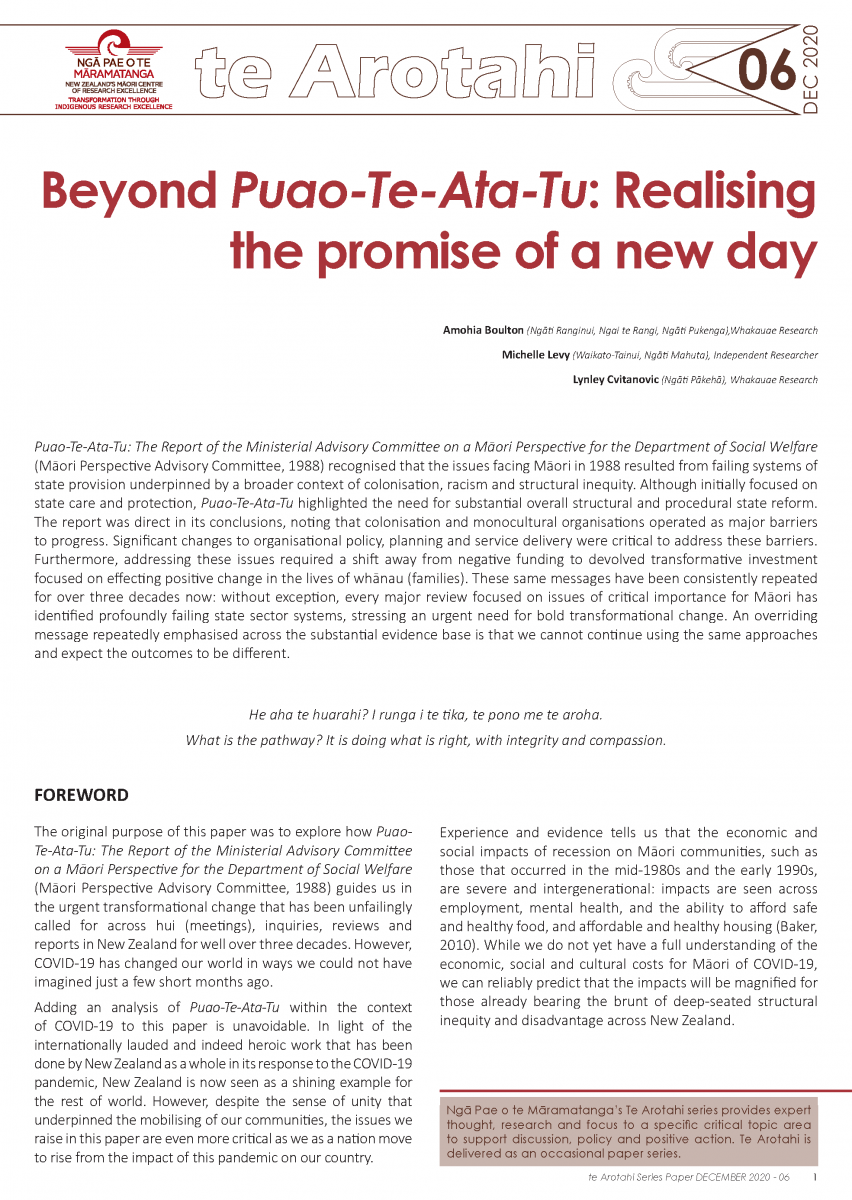
Beyond Puao-Te-Ata-Tu: Realising the promise of a new dayAuthors: Amohia Boulton (Ngāti Ranginui, Ngai te Rangi, Ngāti Pukenga), Michelle Levy (Waikato-Tainui, Ngāti Mahuta) and Lynley Cvitanovic (Ngāti Pākehā)
Scholars at Ngā Pae o te Māramatanga call for a 1988 report to be our blueprint for how we begin to restructure our country in the wake of Covid-19.
Written more than three decades ago by Māori for the Department of Social Welfare, Puao-Te-Ata-Tu: Realising the Promise of a New Day recognised that the issues facing Māori resulted from failing systems of state provision underpinned by a broader context of colonisation, racism, and structural inequity. Read more
E te purapura tuawhiti e Mānuka
Kua tuakoka te ao rangahau Māori
Ka ngākau titikaha hei mumu
Kia whakaora anō ai te ohaoha a te Māori
Nāu anō ngā kaupapa tuatinitini, kaupapa taioreore
O Ngā Pae o te Māramatanga i kōkiri i tohutohu ki ōna taumata angitū
Haere rā e te Ihumanea, tē wareware tō rahi tō ihi
Tēnei a Ngā Pae o te Māramatanga e whakamiha e whakamānawa
E Mānuka, our noted and esteemed leader
The Māori research world has become impoverished by your departure
You were a stalwart, resolute, dedicated to the restoration
Of the Indigenous and Māori economy
Traversing the many leadership and advisory roles
Within Ngā Pae o te Māramatanga you ensured excellence and successful achievement
Travel well, for your great contribution will not be forgotten
Tis with deep appreciation and respect, Ngā Pae o te Māramatanga bids you farewell
It is with great sadness that we grieve the passing of our dear friend Associate Professor Dr Mānuka Henare.
Dr Henare was a long-serving member of Ngā Pae o te Māramatanga who provided critical research leadership and mentorship in the fields of mātauranga, Māori and Indigenous business enterprise, development economics, history, and Te Tiriti o Waitangi.
In 2020, NPM announced one of three new and prestigious Named Summer Internship Scholarships, and in consultation with Mānuka's whanau this named scholarship “Whai Rawa Whai Ora: A tribute to Mānuka’s vision for a healthy Māori wellbeing economy” was founded in recognition of Dr Henare's exceptional contribution to Māori leadership and scholarship.
Our deepest condolences go out to the whānau at this time.
Kei te mūrau a te nuipuku
Nei a Ngā Pae o te Māramatanga e mihi e tangi
Haere e Te Aitanga a Tiki, okioki ai
Māori professors from across all 8 of Aotearoa New Zealand’s Universities, write a second letter to the government reissuing their call for an urgent national review of the tertiary sector for Te Tiriti o Waitangi compliance.
They are seeking to meet with the Minister of Education & Māori Crown Relations to ask for the government’s help and leadership in issuing a statement of expectations, conducting a Tiriti audit, and developing and financing an action plan to transform institutional leadership to meet the expectations of the Tertiary Education Strategy 2020.
NPM'S 2020-21 Summer Internship programme is about to start again with an outstanding group of aspiring emerging Māori researchers, working with our NPM Researchers all over the country and engaged in an exciting range of projects across our research themes.
With over 70 students applying for the coveted internships, our selection panel had an extremely difficult task in selecting the successful interns.
Three of the interns have been awarded NPM’s new and prestigious Named Summer Scholarships, which honour and recognise the contribution and commitment of three of our esteemed researchers and scholars who have contributed significantly to Māori leadership and scholarship; Professor Michael Walker, Associate Professor Mānuka Hēnare and Professor Te Wharehuia Milroy.
The interns and supervisors will come together online throughout the summer programme, meeting as a national rōpu on a fortnightly basis to share and be inspired by the career stories, insights and experiences of notable senior Māori leaders and researchers.
We congratulate all the confirmed recipients, who will be working throughout the summer to deliver what are a series of highly anticipated research reports early in 2021.
NEW PRESTIGIOUS INTERNSHIPS HONOURING ESTEEMED SCHOLARS
Named Internship - Professor Michael Walker; Understanding a taonga species: He Kohinga Mātauranga, He Iti Pounamu
Ria Hodges (Ngāti Toa) Victoria University of Wellington
Supervisors: Dr Ocean Mercier & Professor Helen Moewaka Barnes, Victoria University of Wellington & Massey University
Named Internship - Associate Professor Mānuka Hēnare; Whai Rawa Whai Ora: A tribute to Mānuka Hēnare’s vision for a healthy Māori wellbeing economy
Moana Ellis (Kahungunu, Tūwharetoa, Uenuku) University of Canterbury
Supervisors: Dr Shaun Awatere & Professor Chellie Spiller, Manaaki Whenua & University of Waikato
Named Internship - Professor Wharehuia Milroy; Understanding, articulating and measuring the language shift at the micro-level
Te Maiora Rurehe (Tūhoe, Te Arawa) University of Waikato
Supervisor: Dr Gianna Leoni, University of Otago
SUMMER INTERNS 2020-21
Taimana Iversen (Ngāi Te Rangi, Ngāti Whakaue) University of Auckland
Project title: Short Histories from Te Ao Hurihuri
Supervisor: Associate Professor Aroha Harris, University of Auckland
Tamahina Sheridan (Te Aitanga a Hauiti, Rongowhakaata, Ngāi Tāmanuhiri, Te Whānau a Apanui, Te Ātihaunui-a-Pāpārangi, Ngāti Rangi, Ngā Rauru) Victoria University of Wellington
Project title: Whakamanu Research Project
Supervisors: Dr Rāwiri Tinrau, Meri Haami & Susan Wakefield, Te Atawhai o Te Ao
Matthew Wilson (Taranaki - Ngā Mahanga, Titahi) Massey University, Wellington
Project title: Whakarauora Research Project
Supervisors: Dr Rāwiri Tinrau & Meri Haami, Te Atawhai o Te Ao
Reumah Horne (Ngāti Kahu ki Whangaroa, Ngāti Pikiao, Te Arawa, Ngāi Te Rangi) University of Auckland
Project title: Mairangitia te angitū: Māori role models and aspirations for the future – iwi perspectives
Supervisor: Associate Professor Melinda Webber, University of Auckland
Sequoia Short (Tainui) University of Otago
Project title: Creating Treaty-based Procurement Pathways
Supervisor: Dr Katharina Ruckstuhl, University of Otago
Waratah Taogaga (Ngāti Whātua, Ngā Puhi) University of Auckland
Project title: Māori and Pasifika First in the Family doctoral students postgraduation and employment.
Supervisor: Dr Hinekura Smith, University of Auckland
Dawson Marama-Feagai (Ngāti Whakaue, Te Arawa) Te Wānanga o Aotearoa
Project title: Ka pū te ruha, ka hao te rangatahi
Supervisor: Dr Teah Carlson, Massey University
Mona-Lisa Wareka (Ngātiwai, Ngāti Rereahu) University of Waikato
Project title: Towards a Māori integrative framework for Aotearoa New Zealand
Supervisor: Ms Yvonne Taura, Manaaki Whenua Landcare Research
Janine Copeland (Tūhoe, Ngāti Awa, Te Whakatōhea, Te Arawa) Te Whare Wānanga o Awanuiārangi
Project title: Ko ahau te kēnge, ko te kēnge ahau. I am the gang and the gang is me. Māori identity within gangs and society’s acceptance of them
Supervisor: Ms Fiona Wiremu, Te Whare Wānanga o Awanuiārangi
Te Ao Leach (Ngāti Whakaue, Ngāti Rangiwewehi, Ngāti Pikiao, Ngāti Porou, Ngāti Rīwai, Te Aitanga a Hauiti) University of Auckland
Project title: Reconsidering longitudinal data for whānau wellbeing interventions – a rangatahi perspective
Supervisor: Dr Naomi Simmonds, Te Whare Wānanga o Awanuiārangi
Keziah Lawes (Kai Tahu, Taranaki) University of Otago
Project title: Wāhine Māori and Work
Supervisor: Dr Nimbus Staniland, Auckland University of Technology
Katie Lee Riddle (Rongowhakaata) University of Waikato
Project title: Tools to enhance Indigenous Control of Indigenous Data - Traditional Knowledge Licenses
Supervisor: Associate Professor Maui Hudson, University of Waikato
Daysha Tonumaipea (Te Arawa) Auckland University of Technology
Project title: Mahi Tahi mo Te Hinonga: Indigenous Collaboration for Enterprise and the role of Indigenous Business Networks
Supervisor: Associate Professor Ella Henry, Auckland University of Technology
Claudia Palmer (Te Rarawa me Te Aupо̄uri) Whitireia New Zealand
Project title: Māori Audience and Engagement with Heritage
Supervisor: Dr Annemarie Gillies, Heritage New Zealand Pouhere Taonga
Louisa Donnell (Ngāti Raukawa, Ngāti Toa) Te Wānanga o Raukawa
Project title: Māori Heritage: Developing an Iwi Heritage Plan
Supervisor: Dr Annemarie Gillies, Heritage New Zealand Pouhere Taonga
Victoria Maikuku (Waikato, Ngāti Maniapoto, Ngāti Apakura, Ngāti TeAta) University of Waikato
Project title: He taonga kē te ngahere
Supervisor: Dr Bridgette Masters-Awatere, University of Waikato
Phoenix-Rose Mansell (Ngāti Awa) University of Canterbury
Project title: Haumanu Hauora: Strengthening health institution Māori responsiveness to climate adaptation
Supervisor: Dr Trish Young, University of Waikato
Ben Shine (Ngāi Tahu) University of Otago
Project title: E Tū Kahikatea: Developing psycho-cultural consciousness in the changeful world of rangatahi
Supervisor: Professor Angus Macfarlane, University of Canterbury
Kelsey Metcalfe (Te Aupōuri) Unitec Institute of Technology
Project title: He tātai whetu ki te rangi, he rangatahi ki te kāinga: Rangatahi pathways to safe, secure and affordable homes.
Supervisor: Professor Jenny Lee-Morgan, Unitec Institute of Technology
Aroha Dykes (Te Atihaunui-a- Paparangi, Tuwharetoa, Ngāti Uenuku) Unitec Institute of Technology
Project title: The impact of state violence on whānau has a direct correlation and to whānau violence and sexual violence
Supervisor: Ms Rihi Te Nana, Unitec Institute of Technology
Maia Nikora-Davis (Te Whakatōhea, Ngāti Kōnohi, Ngāti Raukawa) University of Auckland
Project title: Imagining trajectories for rangatiratanga – exploring rangatahi and tamariki Māori voices
Supervisor: Dr Sarah-Jane Paine, University of Auckland
Fern Kumeroa (Ngāti Ruanui) Massey University Palmerston North
Project title: Invertebrate species as key indicator of biodiversity on Taranaki Mounga
Supervisors: Dr Simon Hills & Professor Doug Armstrong, Massey University
Jonathan Pirini (Te Rarawa, Nga Puhi, Te Arawa) Victoria University of Wellington
Project title: Māori Jazz – the Aotearoa New Zealand experience and future horizons
Supervisor: Associate Professor Meegan Hall, Victoria University of Wellington
Maia Te Hira (Ngāti Kahungunu, Te Rarawa, Ngāti Kuri, Ngāi Takoto) University of Auckland
Project title: Kāinga Rawa: Literature review of the Missing Middle Demographic for Ngāti Whātua Orākei
Supervisor: Irene Kereama-Royal, Unitec Institute of Technology
Taonga Te Moni (Te Arawa, Ngāti Whātua, Ngāpuhi, Ngāti Porou) University of Auckland
Project title: Mapping racism in the university environment
Supervisor: Dr Donna Cormack, University of Auckland
Te Oranoa Matthews (Te Rarawa, Ngāti Ranginui) University of Auckland
Supervisor: Dr Donna Cormack, University of Auckland
Project title: Teaching into racialised spaces in the health sciences
Ruawhaitiri Mahue (Ngāti Porou) Waikato University
Project title: Te Whanaketanga o Te Aka
Supervisor: Dr Dean Mahuta, Auckland University of Technology
Briar Pomana (Ngāti Kahungunu, Ngāti Rākaipaaka, Rongomaiwāhine) Auckland University of Technology
Project title: Tihei Mauri Moko - reclaiming and evolving tikanga around receiving and carrying moko kauwae
Supervisor: Dr Hinekura Smith, University of Auckland
Ricco Niha (Ngāpuhi, Ngāti Whātua, Ngāti Hine) University of Auckland
Project title: Understanding Māori cultural narratives of organ/tissue donation
Supervisor: Dr Karyn Paringatai, University of Otago
Elizabeth Dewes (Ngāti Porou) Victoria University of Wellington
Project title: Raranga Tāngata, Oranga Tāngata – The provision and integration of Māori primary health care through a pandemic and beyond
Supervisor: Dr Lynne Russell, Victoria University of Wellington
Congratulations again to all these students receiving a NPM Internship. And our thanks to the researchers who will supervise, support and mentor. Ngā mihi nui ki a koutou!
HUNDREDS LOG ON FOR THE 9TH BIENNIAL INTERNATIONAL INDIGENOUS RESEARCH CONFERENCE!
NPM Co-Director, Professor Jacinta Ruru gives a wrap-up of IIRC20
Last week, Ngā Pae o te Māramatanga hosted one of the largest ever global online gatherings of Indigenous-led research. Our 9th International Indigenous Research Conference - but our first online - exceeded all expectations.
Our deepest thanks to our more than 150 Indigenous researchers who shared their expertise on issues from economic empowerment to seeking a decolonised world that values Indigenous solutions for multiple crises confronting societies from Covid-19, climate change, poverty, biodiversity loss to racism and inequity.
We expresses our gratitude to the 600 registered online attendees who helped to make the conference so special, memorable and fun. We all bravely rose to the challenge of digital knowledge sharing while still retaining our Indigenous practices of sitting together.
I’m so proud of what was achieved, it was magic. We reached people from all around the world, many of whom have never been able to afford the in-person conference experience.
I loved every minute of it. The positive transformative potential of Indigenous research was on show in fine form for all to see. A truly uplifting event that will keep on giving with new global and national collaborations now formed
As a deeply related community of Indigenous researchers internationally, we come together in the one place every two years, this year was like no other and we are proud to acknowledge our collective engagement and activism across these new and dynamic online environments to re-imagine our very first online "Gathering of Indigenous Minds".
We look forward to hosting the 10th Biennial International Indigenous Conference in 2022!
NPM recently celebrated the award of 7.5 years of Centre of Research Excellence funding from 2021 - 2028, and with the end of our current Centre funding looming (recently extended to 30 June 2021) changes in staff are a foot. We have departures from our leadership groups as well as the Auckland based secretariat.
We noted and celebrated Professor Poia Rewi’s contributions, leading NPM's Te Reo me Ngā Tikanga Māori programme for the past few years, with his move to CEO of Te Mātāwai recently. In addition, our fabulous AlterNative Journal Co-ordinator Te Kororia Netana transitioned to a new role with the Ministry of Culture and Heritage, based at the University of Auckland.
While we have had farewells and departures we are pleased to welcome additions to the team, Wiremu Meha (Te Aitanga ā Māhaki, Ngāti Kahungunu, Rangitāne, Te Roroa, Te Aupouri) takes on the role of Journal and Publications Coordinator – AlterNative, and comes to NPM from University of Auckland Teaching and Learning. Wiremu (pictured) holds a Bachelor of Science in Biological Sciences from Brigham Young University–Hawaii, and a Bachelor of Human Biology from the University of Auckland. He also holds a Diploma in Applied Science (Animal Biology) from the University of Waikato, and a Graduate Diploma in Teaching (Secondary) from the University of Auckland.
We have also been very pleased to welcome two new leaders to our Research Leadership team recently - Associate Professor Meegan Hall (Ngāti Ranginui, Ngāti Tūwharetoa) - Victoria University of Wellington, and Dr Karyn Paringatai (Ngāti Porou) - University of Otago.
Meegan is Associate Professor at the Centre for Academic Development and Assistant Vice-Chancellor (Mātauranga Māori) at Victoria University of Wellington and leads NPM's Professional Excellence Strategy. She specialises in Māori academic development - academic practice and higher education learning and teaching; Māori studies; kaupapa Māori and Māori-centred methodologies; Māori academic practice, Māori pedagogies and Māori student achievement in higher education.
Karyn has taken on the role of NPM's Pae (Theme) leader Te Reo Me Ngā Tikanga Māori. Karen is currently a Programme Coordinator for Master of Indigenous Studies (MIndS) at Te Tumu and her research interests include sociological issues surrounding Māori urbanisation, Māori identity development and maintenance, Māori performing arts and the analysis of haka and waiata compositions. Her research encompasses the role kapa haka plays in identity, grammatical aspects of the Māori language and second language acquisition and Māori language and Māori performing arts teaching methodologies.
The ongoing work of Indigenous scholars and researchers, including several of our Māori academics, in Indigenous data sovereignty is presented in a new edited open access book ‘Indigenous Data Sovereignty and Policy’.
This open access book can be read and downloaded here and examines how Indigenous Peoples around the world are demanding greater data sovereignty, and challenging the ways in which governments have historically used Indigenous data to develop policies and programs.
In the digital age, governments are increasingly dependent on data and data analytics to inform their policies and decision-making. However, Indigenous Peoples have often been the unwilling targets of policy interventions and have had little say over the collection, use and application of data about them, their lands and cultures. At the heart of Indigenous Peoples’ demands for change are the enduring aspirations of self-determination over their institutions, resources, knowledge and information systems.
NPM Researchers and Māori authors contained within the book include; Incoming NPM Co-Director Professor Tahu Kukutai, Professor Papaarangi Reid, Dr Donna Cormack, Associate Professor Bridget Robson, Dr Sarah-Jane Paine, Associate Professor Ricci Harris, Associate Professor Maui Hudson, Andrew Sporle and Kiri West.
NPM Co-Director Professor Jacinta Ruru, Associate Professor Angela Wanhalla and Jeanette Wikaira have released the Read our Words poster, profiling ten easily accessible Māori authored non-fiction books.
The poster encourages the public to engage with the voices and experiences of Māori to help create an anti-racist Aotearoa New Zealand.
“One way for New Zealanders to help create an anti-racist nation is to ‘read our words’ and engage in the depth and diversity of Mātauranga Māori. Māori writers have been resisting and challenging racism since Pākehā and the written word first arrived in Aotearoa. This poster reminds Aotearoa of this, and we hope it will be printed and posted in corridors throughout the country in schools, community halls, marae and public libraries,” Professor Ruru says.
The poster is the latest undertaking from the Te Takarangi team who initially produced a curated list of 150 Māori Non-Fiction books from 1815 to 2017.
“The poster has been something we have wanted to do since the inception of our Te Takarangi project, and our vision is to see the posters pinned up in every school and library in the nation, promoting Māori scholarship, Mātauranga Māori and combating racism”, Wikaira says.
Download the Poster here
In acknowledging the diverse Māori language activity and research, NPM and Te Mātāwai partnered to co-host an important te reo Māori symposium at the Otago Museum, Dunedin, on the 8th and 9th of October. Led and organised by NPM Programme Leaders and University of Otago academics Dr Tangiwai Rewi and Dr Gianna Leoni, this research event was focused specifically on Māori language revitalisation initiatives and brought together Māori language leaders, researchers, community practitioners, evaluators and data experts to share their current insights and knowledge on reo ūkaipō and reo ūkaiawatea.
Recent NPM Board Member, University of Auckland Pro-Vice Chancellor (Māori) and former Children's Commissioner Professor Cynthia Kiro has been appointed Ahorangi - Chief Executive of the Royal Society Te Apārangi.
Cindy Kiro (Ngāpuhi, Ngāti Kahu, Ngāti Hine) is a long time NPM researcher and supporter, contributing at various levels to NPM over the years. Her recent focus at the University of Auckland has been on developing a positive Māori profile and a Te Reo Māori Strategy within and for the university as well as helping develop Māori programmes in liaison with the Vice-Chancellor, Māori staff, students and the community.
Commenting on her appointment Professor Kiro said that now is "the time for staged, considered advice about science, research, mātauranga and rangahau" and that she is "excited to see how that knowledge can be used to better inform what we do and to inform the public.”
NPM's congratulations go to Professor Kiro in her new role. We are all very excited to see what she will bring to the organisation as the latest in a long line of influential Royal Society Te Apārangi leaders.
Also of note is the appointment last week of two long time contributors to NPM as Ngā Takahoa a Te Apārangi Companions of Royal Society Te Apārangi. NPM Tohunga and Researcher Dr Tā Tīmoti Kāretu was recognised by the Society for his supreme efforts in revitalising te reo Māori. At the same time an early leader of NPM, Rauru Kirikiri was recognised by Te Apārangi for his groundbreaking work in embedding mātauranga Māori into science across Crown Research Institutes and universities, and for bringing te ao Māori perspectives into tertiary education and beyond.
Royal Society Te Apārangi recently convened a multidisciplinary panel of leading experts to examine issues of equality, equity, and fairness in Aotearoa. The panel’s name, Te Tapeke, comes from the saying ‘ka tapeke katoa te iwi’ and conveys valuing and including all people.
NPM Principal Investigator and University of Auckland academic Associate Professor Andrew Erueti is the Co-Chair of the Te Tapeke Fair Futures Panel and has recently published his own short paper, which emerged out of the Inquiry into Abuse in Care which is investigating child abuse from the 1950s in both state and faith-based institutions, including foster care, and psychiatric and disability residences.
Andrew was asked to think about fairness in a Māori context and expresses that tikanga Māori has an important role to play in the journey towards fairness, equality, and equity – and determining what types of solutions might lead to positive change for all New Zealanders.
Read the paper here
Kia hiwa rā! kia hiwa rā!
Kia hiwa rā i tēnei tuku!
Kia hiwa rā i tērā tuku!
Kia tū, kia oho, kia mataara e!
Pū te koa i te whakapuakitanga e tūpapahū nei.
Ka whakamihatia, ka whakamānawatia ngā ihuoneone o te kaupapa.
Koutou katoa e whakapeto ngoi ana, e okea ururoatia kia ū ai ki tā
Ngā Pae matekitenga, whāinga, whakataukī anō hoki.
Nei anō a Ngā Pae o te Māramatanga e ngunguru nei, au, au, auē, hā! Hī!!
Last Friday, 9 October, the Tertiary Education Commission announced the outcome of the 2019/2020 Centre of Research Excellence (CoRE) funding round.
Ngā Pae o te Māramatanga (NPM) is proud to be amongst those CoREs, both established and new, who have confirmed funding from July 2021 – December 2028.
Over the past 18 years NPM has demonstrated its excellence and focus on expanding the reach and impact of mātauranga Māori across the spectrum of research outcomes in Aotearoa New Zealand working closely with communities and its partners. We are sincerely grateful for the continued support of our communities, researchers, students and partners and extend our thanks to all who contributed to making our bid successful.
NPM Co-Director Professor Linda Waimarie Nikora commented that this was a time of celebration and an acknowledgement of hundreds of Māori researchers, our communities, and partners who have worked with NPM over almost two decades.
“We give our thanks to all of those who have come before us and look forward to extending the impact of Ngā Pae o te Māramatanga and building further recognition and outcomes from Māori and Indigenous Research with our communities over the years ahead, as we seek flourishing futures for Māori and the whole of Aotearoa.”
NPM acknowledges the current Co-Director Professor Jacinta Ruru (University of Otago), our incoming Co-Director Professor Tahu Kukutai (University of Waikato) and our Board, Research Leadership Team and Secretariat, without whom this successful rebid would not have been possible.
NPM’s new CoRE contract will commence 1 July 2021, with funding for 7.5 years at $5 million per annum.
Over the coming weeks further details of NPM’s evolved research plan and focus will be shared.
ENDS
View a short video showcase of what NPM has built over the past CoRE contract here;http://mediacentre.maramatanga.ac.nz/content/npm-showcase
Applications for NPM's Summer Internship Programme are open once again! 30 summer internship positions will be selected and confirmed from the 49 project proposals.
These are open for our tauira to apply, review the projects, then get your CV and application together and apply by 12 October!
In 2020 we are also including three special named inaugural internship awards. These scholarships honour three of our esteemed NPM scholars and their whānau.
Professor Michael Walker Scholarship: Understanding a taonga species: He Kohinga Mātauranga, He Iti Pounamu for our Te Tai Ao Research Theme
Associate Professor Mānuka Hēnare Scholarship: Whai Rawa Whai Ora: A tribute to Mānuka Hēnare’s vision for a healthy Māori wellbeing economy for our Whai Rawa Research Theme.
Professor Wharehuia Milroy Scholarship: Understanding, articulating and measuring the language shift at the micro-level for our Te Reo me ngā Tikanga Māori Research Theme.
Our Summer Internships are for students interested in gaining some real research experience, and working with senior NPM researchers over the coming 2020-2021 summer. The internship programme is intended to provide experience and support for Māori students interested in pursuing research.
All tauira should review the projects and submit their applications for an NPM Summer Internship link here now!
Applications close 12 October!
Recent weeks have seen an increased focus on issues of inequality and racism in Aotearoa's educational system, particularly within its tertiary sector. NPM is sharing recent open letters regarding action called for by many Māori and Indigenous academic colleagues internationally.
An open letter signed by 6840 academics and scholars from around Aotearoa and the world was published this week calling for the University of Waikato to act, on the issues of institutional racism and inequities, and to actively demonstrate its commitment to the Treaty of Waitangi, to mātauranga Māori and te reo Māori. Download a copy of this letter here.
Māori professors from across Aotearoa New Zealand’s Universities have also sent an open letter to the Minister of Education calling for a national review of Universities. This letter signed by 37 Māori professors can be viewed here.
Dr Sereana Naepi and Professor Margaret Mutu were interviewed on Breakfast on One on the morning of Friday 18 September, discussing many of these concerns and issues. You can view a video of this interview here.
NPM Researchers have this week been celebrating successful proposals in the 2020 round of the Endeavour Fund, which plays a unique role in the science system through an open, contestable process with a focus on both research excellence and a broad range of impacts.
The fund encourages researchers to sample a diverse range of ideas and conduct excellent research, with transformational potential and seeks to deliver impacts across a range of economic, environmental and societal objectives, and give effect to Vision Mātauranga.
NPM acknowledges the success of Professor Tahu Kukutai, University of Waikato, NPM Principal Investigator, with her teams project Tikanga in Technology: Indigenous Approaches to Transforming Data Ecosystems and also Professor Philipa Howden-Chapman, University of Otago with NPM Co-Director Professor Jacinta Ruru as a named second investigator for the project Public Housing and Urban Regeneration: Maximising Wellbeing.
In Te Wiki o Te Reo Māori, one of NPM Principal Researchers in Te Reo me ngā Tikanga Māori, Dr Rachael Ka'ai-Mahuta of Te Ipukarea, published an article in The Conversation highlighting her current NPM research and Making te reo Māori cool: what language revitalisation could learn from the Korean Wave – check out this article here in both te reo Māori and English.
Rachael and team’s NPM research focusses on how the Māori language can be better supported in the lives of adolescents and is based on the idea that the Māori language of adolescence forms the building blocks of non-formal adult language.
“... preliminary findings show the potential strategic importance of the adolescent age group for Māori language revitalisation. Teenagers are trendsetters – as such, they can have an impact on (and be influenced by) the perceived value of the Māori language and therefore its status.”
NPM Researcher Dr Dan Hikuroa has contributed to the recently published book Communicating Science: A Global Perspective. This book includes a chapter on Aotearoa New Zealand, entitled “Participatory science and bicultural knowledge communication” and documents the global emergence of modern science communication.
The Aotearoa New Zealand chapter was written by Jean Fleming (Centre for Science Communication, The University of Otago), Nancy Longnecker (Centre for Science Communication, The University of Otago), Rhian Salmon (Centre for Science in Society, Victoria University of Wellington and Te Pūnaha Matatini) and Daniel Hikuroa (University of Auckland, Te Pūnaha Matatini and Ngā Pae o te Māramatanga) and is available to read and download here
Nō mātou te whiwhi! Piri mai ki te whakarongo ki ngā Tumu Whakarae o Māori Television, Te Māngai Pāho me Te Mātāwai. Ka whakaputaina i ō rātou whakaaro e hāngai ana ki te mahi ngātahi mō te rangahau i te reo Māori te kaupapa i raro i Te Papa Kōrero. Nau mai, hono mai rā hei kaupapa whakakapinga mō Te Wiki o Te Reo Māori.
Join our panel of chief executives in a live video webinar session this Friday 18 September at 2pm as they share their ideas about working together for te reo Māori research under Te Papa Kōrero.
Who: Shane Taurima (Māori Television), Larry Parr (Te Māngai Pāho), Ngahiwi Apanui (Te Taura Whiri i te Reo Māori) and Dr Poia Rewi (Te Mātāwai), facilitated by Dr Gianna Leoni and Dr Tangiwai Rewi from Te Tumu at the University of Otago.
When: Friday 18 September 2pm - 3.30pm
To Attend This Webinar You Must REGISTER HERE
Te Papa Kōrero includes the Chief Executives of Te Puni Kōkiri; Te Taura Whiri i te Reo Maori; the Ministry of Education; the Ministry for Culture and Heritage; Te Mātāwai; Te Māngai Pāho; the Māori Television Service; and the Department of Internal Affairs. The purpose of Te Papa Kōrero is to provide coordination and leadership for the implementation of both Maihi (Maihi Māori and Maihi Karauna)
Shane Taurima (Rongomaiwahine, Ngāti Kahungunu), joined Māori Television as Deputy Chief Executive in September 2018 and was appointed Chief Executive in May 2019. With more than 25 years’ experience across media and broadcasting, Shane started off his career in iwi radio and went on to manage the national Māori radio news service, Ruia Mai.
Larry Parr (Ngāti Hikitanga, Ngāti Raukawa me Muaūpoko) is a ground-breaking industry executive and film and television producer. He took up the CEO role at Te Māngai Pāho in October 2016. The Board was delighted to have Larry to lead the organisation into the new environment established by the Māori Language Act 2016. Larry was previously the television and new media funding manager at Te Māngai Pāho and also head of programming at Māori Television.
Ngahiwi Apanui (Ngāti Porou, Ngāti Hine and Te Whānau a-Apanui, Ngāti Kahungunu, Tūhoe) joined Te Taura Whiri i te Reo Māori in August 2015 after six years as the Deputy Director Māori of Ako Aotearoa, The National Centre for Tertiary Teaching Excellence. Ngahiwi is a certified translator and has a wealth of experience in education and the government sector, plus time as a manager in Māori broadcasting. He has launched three solo te reo Māori albums and has a Māori language speaking home with five children who are also Māori language speakers.
Poia Rewi (Ngāti Manawa, Tuhōe, Tūwharetoa, Te Arawa) was appointed as CEO of Te Mātāwai on 1 July 2020 and brings with him a plethora of expertise, as the former Professor and Dean of Te Tumu, School of Māori, Pacific & Indigenous Studies at the University of Otago, and the Te Ahu o te Reo research. He is well-known for his work in Māori language revitalisation, whaikōrero and research. He was a deputy director of NPM and formerly led the Te Reo Me Ngā Tikanga Māori research platform.
Five of the nine recipients of the Ako Aotearoa Tertiary Teaching Excellence Awards this year are outstanding Māori tertiary teachers. Winning awards in the Kaupapa Māori category were: Associate Professor Anne-Marie Jackson, Dr Awanui Te Huia, Kay-Lee Jones, Dr Rhys Jones and Yo Heta-Lensen.
The online awards ceremony, MC’d expertly by Dr Karyn Paringatai, got even more exciting when the big prize – the 2020 Prime Minister's Supreme Award – was awarded to NPM Researcher and University of Auckland, Te Kupenga Hauora Māori, academic Dr Rhys Jones.
Rhys is an outstanding champion of teaching and learning, where he weaves together values from te Ao Māori, Kaupapa Māori frameworks, Indigenous Peoples' human rights and medicine. He is recognised as "courageous, transformative, and emancipatory."
"We need to go beyond the concept of transformative learning within a Kaupapa Māori framework, and seek to transform educational curricula, educational institutions and society in which they are embedded" says Dr Jones.
He has been at the forefront of Māori and Indigenous advocacy in medical health science in both Aotearoa New Zealand and on the world stage. Medical health inequalities require care and depth in teaching and learning, as Dr Jones shares, “Many students find this confronting; it involves questioning of accepted ‘truths’ about New Zealand history and society, and engagement with concepts such as colonisation, racism and privilege”.
NPM congratulates all five recipients who are all exceptional Māori academics, and celebrates this recognition of their deep and enduring contribution to teaching excellence in Aotearoa New Zealand.
On the 31st August, an NPM panel of esteemed Māori researchers met in a live video webinar session to investigate, expose and discuss the ethics of rationing health in a racialised society.
Professor Papaarangi Reid facilitated a discussion between Professor Linda Tuhiwai Smith, Associate Professor Krushil Wātene and Dr Donna Cormack, where they explored the topic of Rationing Māori Life and Well-Being - Who Decides and How?
Following the rapidly evolving COVID-19 pandemic internationally, there have been dramatic images of overwhelmed health services. And so all tools being developed in NZ must have as starting points a commitment to be Te Tiriti o Waitangi aligned, pro-equity and anti-racist.
This highly successful webinar was supported by Ngā Pae o te Māramatanga and Te Rōpū Whakakaupapa Urūta and during the 90 minute discussion attracted an online audience of more than 300 attendees.
The video of this webinar is now available online for viewing here
This week, Māori law academics across six law schools released a report calling for a new vision for how we construct, know and teach law in Aotearoa New Zealand.
Our congratulations go to Paora Crawford Moyle (Ngāti Porou), this year's winner of the annual Wāhine Ora Award supported by NPM and New Horizons for Women Trust: Hine Kahukura!
Paora was raised in State care and is now a social worker who has worked for 30 years in the community. Paora is currently completing a doctorate in Māori Health exploring the impact of the removal of tamariki from their whānau, with a particular focus on the separation trauma that tamariki Māori experience and the processes for their cultural recovery and healing.
Paora comments that "the approach speaks to the absolute need for Indigenous peoples’ voices to be centralised within social research and asserts their understandings as the heart of the process and analysis."
Together with New Horizons for Women Trust, NPM celebrates Paora's award and looks forward to the outcomes of this important kaupapa in the months and the years ahead.
Panel: Professor Linda Tuhiwai Smith, Associate Professor Krushil Wātene and Dr Donna Cormack with Professor Tahu Kukutai (Facilitator)
To attend this live Webinar you must REGISTER HERE
Background research and discussion videos include a presentation by Dr Moana Jackson
Aotearoa New Zealand has to date avoided the extreme consequences of COVID-19, which internationally has uncovered how health systems and societies differentially value people and groups. However inequality exists in NZ and many of these values and mechanisms still operate not only within our society and but also within our health system. This webinar will investigate, expose and discuss the ethics of rationing health care in a racialised society - critiquing the use of prioritisation tools in medicine about who gets access to technology like ventilators and ICU.
By doing so it will highlight the health inequities that already exist but which would be exacerbated by COVID-19, and bring into the light issues of relevance to government, health professionals, researchers and communities across Aotearoa.
Do not miss out. Register for this exciting webinar here!
Moana Jackson: Keynote at He Manawa Whenua Indigenous Research Conference 2013
COVID‐19: we must not forget about Indigenous health and equity: Link to article here
PRESENTERS
Professor Linda Tuhiwai Smith (Ngāti Awa, Ngāti Porou) - Faculty of Māori and Indigenous Studies, University of Waikato
Māori draw on a history of survivance in a time of crisis and in this time of COVID-19. My talk reflects on what this says about Māori in terms of how we have mobilised our efforts during the lockdown under COVID-19. It also addresses the failure of the Treaty principle of partnership to be honoured and utilised during this crisis when the Government defaults to a mainstream, we know best, lack of trust relationship to Māori. The talk reflects on the lost opportunities to use Māori leadership, Māori health expertise and Māori service provision during the first weeks of lockdown. It ends with questions about what we need to consider and implement the next time. Link to Linda's video below and here
Krushil Wātene (Ngāti Manu, Te Hikutu, Ngāti Whātua o Orākei, Tonga) - School of Humanities, Massey University
Ideas about fairness pervade our lives and shape the society in which we live. One prominent view is that society is a collection of individuals working together for mutual advantage. On this view, the value of our lives is largely determined by how useful we are. Such a view often ignores the full range of ways in which we (individually and collectively) enrich each other’s lives. For instance, such views often ignore the importance of relationships in their own right, the importance of love, and the importance of acknowledging our own needs and vulnerabilities throughout our lives. Critical discussion and reflection about fairness within the context of social justice should be centrally about equity across the full range of well-being and justice dimensions -- not least in the distribution of health. To have these discussions, we need to be honest about the role of history in shaping disadvantage for some and privilege for others. We need to be clear about how we begin to enhance our relationships with each other. We need to be courageous enough to re-imagine our lives together. Most importantly, we need to rethink basic assumptions that we take for granted. Instead, we need theories and policies that provide us with ways of equitably navigating the challenges that we face, rather than those that create or reinforce them. Link to Krushil's video here
Dr Donna Cormack (Kai Tahu, Kāti Mamoe) - University of Auckland
Discussions about the allocation of health resources in the pandemic have highlighted the broader issue of how prioritisation has become a routine and embedded part of healthcare in Aotearoa New Zealand. Increasingly, healthcare decision-making involves algorithmic approaches and/or automated tools, often claimed to be more fair or neutral. Yet decision-making tools are not ‘value-free’ – they necessarily reflect the values and contexts of the societies and institutions within which they are produced. This presentation will explore the (unspoken) values that sit behind tools such as those proposed to allocate ICU beds during the pandemic, and consider how they reproduce colonial values and ethics. Link to Donna's video here
FACILITATOR
Professor Tahu Kukutai (Ngāti Tiipā, Ngāti Kinohaku, Te Aupōuri) - University of Waikato
Tahu is the incoming Co-Director of Ngā Pae o te Māramatanga and is Professor of Demography at the National Institute of Demographic and Economic Analysis, University of Waikato. She specialises in Māori and Indigenous demographic research and has written extensively on issues of Māori population change, Māori identity, official statistics and ethnic and racial classification. She is a founding member of the Māori Data Sovereignty Network Te Mana Raraunga and the Global Indigenous Data Alliance. She co-edited the landmark book Indigenous Data Sovereignty: Toward an Agenda (ANU Press) and a forthcoming edited volume Indigenous Data Sovereignty and Policy (Routledge).Tahu has undertaken research for numerous iwi, Māori communities, and Government agencies, and is a member of the Chief Science Advisor Forum. She was formerly a journalist and has degrees in History, Demography and Sociology from The University of Waikato and Stanford University.