About this research
The project aims to contribute to the intellectual infrastructure of the discipline of te reo Māori revitalisation by collating oral, visual digital and written sources, including a dictionary, thesaurus and repositories of waiata, haka, and narrative recordings.
The project will answer the following research questions:
- How can mātauranga and tikanga Māori be more easily accessed and applied in contemporary (online) mediums to enhance Māori language learning and teaching and opportunities for Māori communities today?
- What effect and impact does the provision of online resources in and about te reo Māori have on language users and learners and the accessing and application of mātauranga and tikanga Māori?
The Te Whare Matihiko o te Reo project will create an online te reo Māori digital portal (Tomokanga Rauemi Reo Māori (TRRM)) comprising a vast range of te reo Māori and mātauranga created through documentary research, wānanga and interviews.
This will include: all publications in te reo Māori, resources, radio stations, television programmes, community and iwi initiatives such as Māori language groups, websites, and social media; five programmes of 13 episodes each, to broadcasting standard, that have been based on a gaps analysis of data already available; a collection of waiata and haka that have not been published including lyrics with a detailed explanation of the lyrics, a biography of the composer, audio and video files.
The construction of TRRM will be informed by research already undertaken, our own research, user requirements and best practice to provide a user-friendly and effective environment of accessible Māori language and mātauranga.
The project will deliver five interrelated digital components:
- A main portal and advanced search engine;
- A unpublished collection of waiata and haka;
- A Māori thesaurus (He Punakupu Taurite);
- A digital dictionary and app for He Pātaka Kupu (pending approval from Te Taura Whiri)
- Pending further funding in Years 4 and 5, two series of 13 episodes each of interviews in Māori with native speakers to expand the He Pātaka Mātauranga Series.
Objectives of the Research
- To understand how technology and new media can be utilised to revitalise and enable the teaching and learning of endangered and minoritised languages.
- Source and prepare appropriate sources of te reo Māori media for inclusion in the online portal.
- Create an online digital te reo Māori language portal.
Kairangahau · Researchers
 Professor Tania Ka'ai
Ngāti Porou, Ngāi Tahu, Hawaiian, Cook Islands, Samoan
Auckland University of Technology (AUT)
Professor Tania Ka‘ai has worked in tertiary education for over 20 years. As an Indigenous scholar Professor Ka‘ai uses…
Professor Tania Ka'ai
Ngāti Porou, Ngāi Tahu, Hawaiian, Cook Islands, Samoan
Auckland University of Technology (AUT)
Professor Tania Ka‘ai has worked in tertiary education for over 20 years. As an Indigenous scholar Professor Ka‘ai uses…
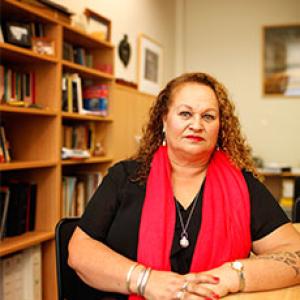
Professor Tania Ka'ai
Ētahi atu · Other projects
What strategies and resources are effective in establishing te reo Māori in the home to raise first language Māori-speaking children? Te Reo o te Pā Harakeke is a three year research project that seeks to understand the factors that contribute to successful intergenerational transmission of the Māori language in the home. The first three years will be a…
View projectTe Reo o te Pa Harakeke
Kairangahau · Researchers
-
Professor Tania Ka'ai
Professor Tania Ka'ai
Professor Tania Ka‘ai has worked in tertiary education for over 20 years. As an Indigenous scholar Professor Ka‘ai uses the cultural values transmitted to her by her elders and mentors as an epistemological framework which informs her own academic writing and teaching (including supervision) within the university academy. Her work as Director of Te Ipukarea and Te Whare o Rongomaurikura, provides an opportunity to share her knowledge not only with students and staff at AUT and others nationally, but internationally too. Professor Ka‘ai’s work with endangered and minority languages has taken…
Tangi is the ultimate form of Māori cultural and community expression. Addressing the dearth of scholarly information, this study considers tangi practice, whakapapa, changing environments, community values, sharing knowledge, ritual and what it means to be Māori. The research team has been examining the life-values, beliefs and practices related to…
View projectAituā: Death in a changing Māori World
Kairangahau · Researchers
-
 Professor Linda Waimarie Nikora FRSNZ, HFNZPS

Professor Linda Waimarie Nikora FRSNZ, HFNZPS
Linda Waimarie Nikora is co-director of Ngā Pae o te Māramatanga and a Professor of Indigenous Studies at Te Wānanga o Waipapa, the University of Auckland. She was previously Professor of Psychology and Director of the Maori & Psychology Research Unit at the University of Waikato. Her specialities are in in community psychology, applied social psychology, ethnopsychology and Maori development. Professor Nikora has a celebrated research and academic career, working in community, social and indigenous psychologies, with a specific focus on Māori wellbeing and self-determination. Her research in…
A new report from Ngā Pae o te Māramatanga (NPM) and Manaaki Whenua Landcare Research provides guidance for Te Ao Māori on climate change adaptation and mitigation. He huringa āhuarangi, he huringa ao: a changing climate, a changing world was produced by a multidisciplinary Māori research team working across many research institutions. Using a novel kaupapa…
View project